
Complete Guide · ear curation
Curated Ear-Ear curation Guide:
How to Plan Your Perfect Earscape
Everything about building a curated ear — sequencing, spacing, jewelry coordination, stacked lobe piercings, ear constellation piercings, and the 2026 earscape trends shaping ear curation.
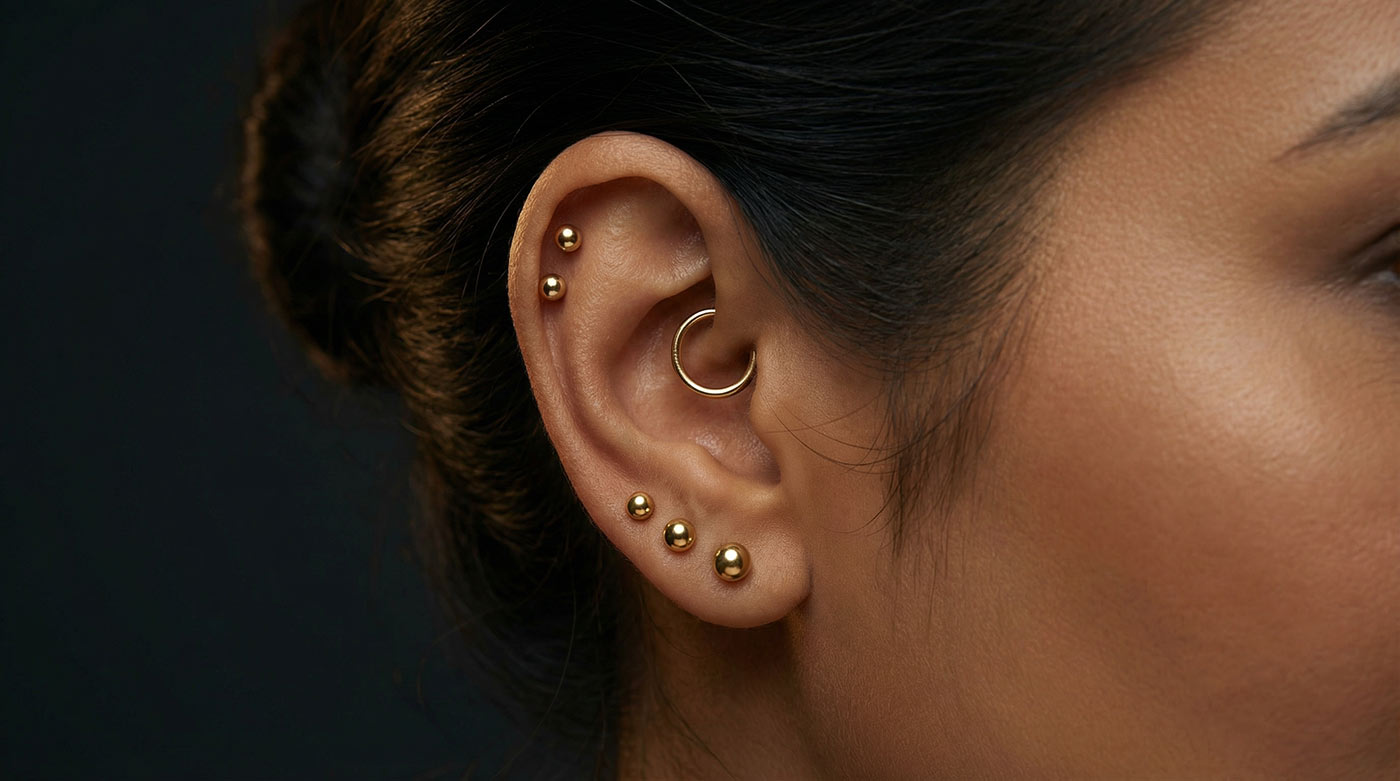
A curated ear is not a collection of random piercings — it is a composed look planned from the start. The difference between a curated ear and a collection of individual piercings is intention: knowing where you are going before you begin.
What Is a Curated Ear (ear curation Earscape)?
A curated ear — also called an earscape — is the intentional design of multiple ear piercings as a single cohesive composition. Rather than adding piercings randomly over time, a curated ear approach involves planning the full layout upfront: which placements, in what order, with what jewelry styles and metals, to create a specific aesthetic once everything is healed.
The curated ear concept was popularised by high-end piercing studios in the early 2010s and has since become the dominant ear piercing approach globally. In 2026, it encompasses everything from a minimal two-lobe and one-helix combination to full 12-piercing stacks covering every part of the ear.
The golden rule of curated ears: Plan all your piercings before you get the first one. The position of your first lobe affects where your second lobe can go. The position of your helix affects whether you can add a forward helix later. Spacing decisions made at piercing #1 ripple through every subsequent placement. See a studio that offers ear curation consultations before booking.
The Correct Sequencing Order
This is the most important practical advice in curated ear building. The order you get piercings matters because healing one placement affects what you can safely add next:
Standard Lobe First
Always the foundation. Heals in 3–6 months. Establishes your base stud or hoop position that every other lobe and cartilage piercing will be placed relative to.
Second & Third Lobe (Month 3–6)
Add lobe stacks while the first heals. Three lobes stacked vertically is the foundation of most curated ears. Space them evenly — your piercer will measure precisely.
First Cartilage — Helix (Month 6–9)
The standard helix is the recommended first cartilage piercing. Lower pain (4/10), accessible for cleaning, and good healing track record. Position it with your full earscape plan in mind.
Second Cartilage — Tragus / Daith / Conch (Month 12–15)
Once the helix is established, add an inner-ear cartilage piercing. Choose based on your planned final look — daith for the inner cluster, tragus for front-of-ear, conch for the bold centre statement.
Fill In & Refine (Month 18+)
Add remaining piercings — double helix, flat helix, rook, additional lobes. Begin swapping initial flat-back studs for healed jewelry: hoops, huggies, chains, and statement pieces.
Never get more than 2–3 new piercings at once. Multiple simultaneous piercings divide your immune system's healing capacity, increase infection risk, and make aftercare significantly harder to maintain. Patience in sequencing produces a better result than rushing the build.
Popular Curated Ear Combinations
These are the most requested earscape builds in professional studios in 2026:
The Classic Stack
Three stacked lobes + standard helix + hidden helix. The entry-level curated ear — achievable in 12 months. Minimal, elegant, and universally flattering.
Inner Ear Cluster
Three lobes + daith + conch (inner stud) + helix. The bold inner-ear focal point build. Takes 15–18 months to build properly. Maximum visual impact.
Quiet Luxury
Two lobes + hidden helix. Three dainty gold studs placed with precision. No hoops, no chains — pure refined restraint. The anti-maximalist earscape of 2026.
Front-of-Ear Build
Three lobes + forward helix + tragus. Creates a concentrated visual cluster at the front of the ear visible from any angle. Striking in profile.
Full Earscape
Three lobes + helix + daith + conch + rook. A fully developed earscape across every zone of the ear. 18–24 months to build. The showstopper ear.
Flat Helix Constellation
Three lobes + four to five tiny flat-back studs arranged across the flat helix panel. Mimics a star pattern. Requires careful advance placement mapping.
Jewelry Coordination for a Curated Ear
The jewelry choices within a ear curation are as important as the piercing placements. Here is how to coordinate effectively:
| Rule | Why It Matters | How to Apply |
|---|---|---|
| Single metal family | Mix of gold and silver looks unintentional | Choose: yellow gold, rose gold, or white gold/titanium — then stick to it |
| Graduating sizes | Uniform sizes look flat — variation creates depth | Larger statement piece (daith/conch) + medium helix + small lobes |
| Mix textures not metals | Texture variety (plain, gem, hammered) adds interest | One gem piece, one plain hoop, one textured stud in each zone |
| One statement per zone | Overcrowding any single zone looks cluttered | Lobe zone: one statement / Cartilage zone: one statement per type |
| Heal in titanium, upgrade to gold | Titanium is safest for healing; gold for healed | Start all piercings in implant titanium → upgrade to 14k gold once healed |
Earscape Trends 2026
The defining curated ear aesthetics of 2026:
Quiet Luxury Stack
Minimal placements, maximum quality. Small dainty gold studs, no oversized pieces. 2–4 piercings only, perfectly spaced.
Heavy One Side
Full earscape on one ear, single lobe on the other. The asymmetric look that lets one ear tell the full story.
Ear Constellation
4–5 tiny titanium studs arranged in a star pattern across the flat helix. The most pinned earscape look of 2026.
Chain Connections
Delicate chains linking two healed piercings (helix to lobe, tragus to lobe). The editorial earscape statement piece.
Triple Lobe Stack
Three perfectly spaced lobe piercings with matched huggies or graduated studs. The foundation of every serious curated ear.
Daith Centrepiece
A bold daith clicker as the inner-ear focal point, surrounded by minimal helix and lobe studs. Drama balanced by restraint.
Frequently Asked Questions
What is a ear curation?
A curated ear is the intentional design of multiple ear piercings as a single composed look. Rather than random individual piercings, a curated ear plans placements, jewelry styles, metals, and sizes to create a cohesive aesthetic. Also called an earscape.
What is the best order to get piercings for a ear curation?
Start with the standard lobe first (heals in 3–6 months). Add second and third lobes while the first heals. Then add your first cartilage piercing (helix recommended) at month 6–9. Add inner-ear cartilage (daith, tragus, conch) at month 12–15. Space each new piercing 3–6 months apart.
What is an ear constellation piercing?
An ear constellation is 3–5 small matching studs arranged across the cartilage in a star-like pattern — usually across the flat helix panel. Requires precise advance planning of placement positions. All studs are small (2–3mm tops) in matching titanium or gold. Very popular in 2026.
How many piercings make a ear curation?
There is no fixed number. Even 2–3 carefully chosen piercings can constitute a curated ear if intentionally planned and coordinated. Most curated ears involve 4–8 piercings built over 12–24 months. What defines a curated ear is intention and planning, not the count.
Planning your earscape?
Drop your questions in the comments — we answer every one!