
Complete Guide · Find a Safe Piercer
How to Find a Safe Piercer:
APP Piercer & Professional Studio Guide
How to find a safe, reputable piercing studio — APP certification, green flags vs red flags, questions to ask, and why professional studios matter.
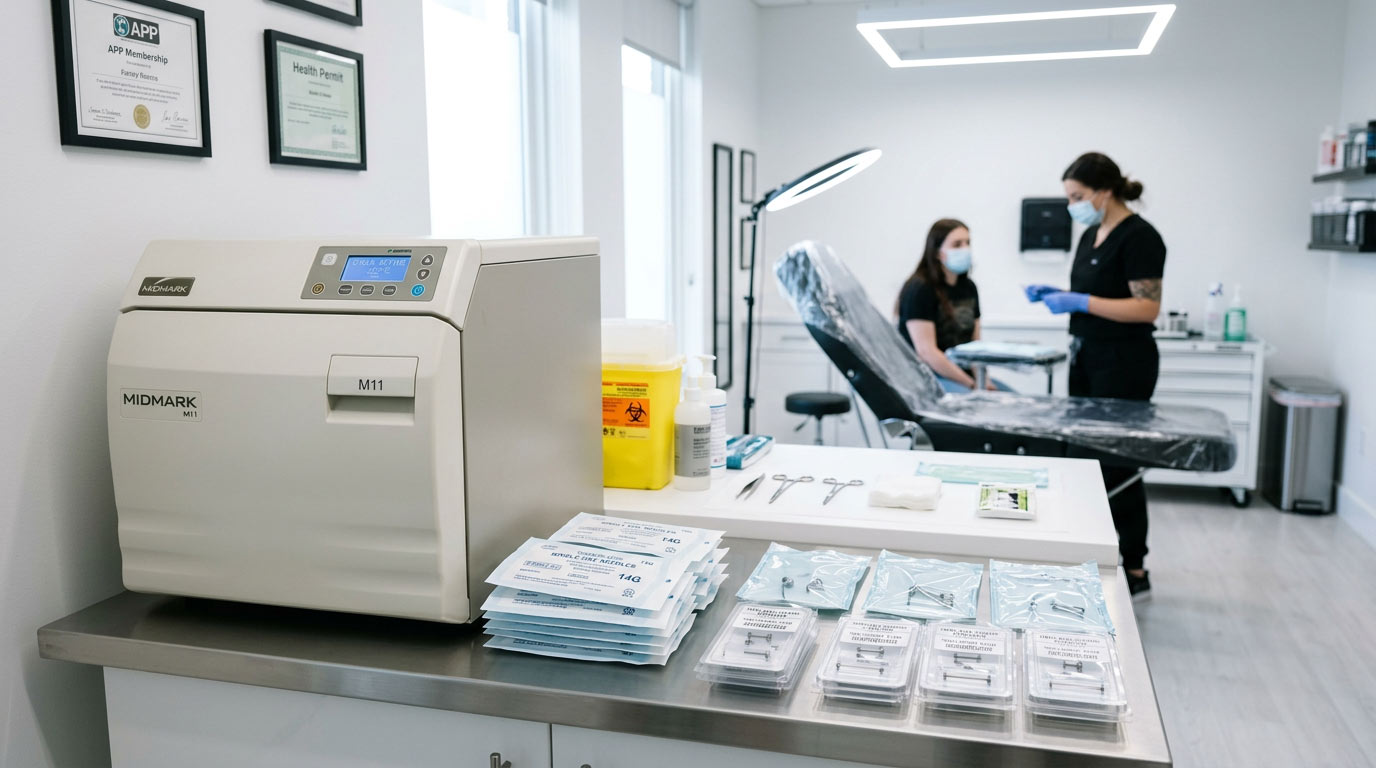
The single most important decision in your piercing journey is not the placement, the jewelry style, or even the aftercare routine. It is the ear piercers. A skilled, certified professional using the correct equipment and materials can make any piercing straightforward. An unskilled or unhygienic piercer can turn even a simple earlobe into a months-long complication.
What Is an APP Piercer?
The Association of Professional Piercers (APP) is the body piercing industry's leading safety and standards organisation, headquartered in the United States with global membership. APP membership is voluntary — ear piercers must apply, meet standards, and maintain annual certification. It is the strongest available signal of professional commitment in the industry.
APP members must meet and maintain the following requirements:
Needle-Only Piercing
APP members must use only single-use, hollow piercing needles. Piercing guns are explicitly prohibited for any piercing by APP standards.
Implant-Grade Jewelry Only
Only implant-grade titanium (ASTM F136), implant-grade steel (ASTM F138), solid gold (14k+), or niobium is permitted for initial piercings.
Blood-Borne Pathogen Certification
All APP members must maintain current blood-borne pathogen (BBP) certification — covering prevention of transmission of bloodborne diseases in a piercing context.
Autoclave Sterilisation
All reusable equipment must be sterilised in an autoclave (steam steriliser). APP members must have their autoclave spore-tested regularly to confirm it is functioning correctly.
Find an APP piercer near you: Visit safepiercing.org/find-a-ear piercers to search the official APP member locator by location. APP membership is the most reliable filter for professional piercing standards available online.
How to Find a Safe Studio — Step by Step
Search the APP Member Locator First
Go to safepiercing.org and use the member finder. APP membership is not a guarantee of perfection, but it immediately filters out studios that cannot or do not meet basic safety standards. Start here, then continue your research on the shortlisted studios.
Read Google Reviews for Specifics
Filter for reviews that mention specific details: cleanliness, ear piercers knowledge, jewelry quality, follow-up service. Ignore reviews that are only about price. Pay special attention to 1-star reviews mentioning infections or complications — these are meaningful signals. Check the studio's responses to negative reviews.
Check Their Instagram / Portfolio
Reputable piercers typically maintain an Instagram portfolio of their work. Look for: healed piercings (not just fresh), complex placements, consistent quality across different anatomies, and evidence of curated ear consultation work. The quality of their photography also reflects the care they take in their work.
Visit the Studio Before Booking
Walk in and look around. The studio should feel as clean as a medical office. You should see visible autoclave equipment, sealed single-use needle packages, and jewelry stored in sealed packaging. Ask if you can see where the piercings are performed. A reputable studio will be happy to show you — a hesitant one should raise concerns.
Ask Questions — Then Assess the Answers
See Section 04 for the exact questions to ask. A knowledgeable, confident piercer will welcome questions. Vague, dismissive, or inconsistent answers are red flags regardless of how professional the studio looks.
Green Flags vs Red Flags
Know what to look for — and what to walk away from:
Green Flags — Book Here
- APP member or equivalent professional certification
- Uses only single-use hollow needles — never guns
- Stocks implant-grade titanium (ASTM F136) explicitly
- Visible autoclave and spore testing records
- Offers anatomy assessment before marking
- Talks you through aftercare without being prompted
- Cleans and gloves up before touching you
- Welcomes questions and answers them specifically
- Studio is visibly clean and uncluttered
- Recommends a downsizing appointment at 4–6 weeks
Red Flags — Walk Away
- Uses a piercing gun for any cartilage piercing
- Cannot name the jewelry material or ASTM grade
- Jewelry is pre-opened or in non-sterile packaging
- No visible autoclave or sterilisation equipment
- Piercer does not wash hands or change gloves
- Significantly cheaper than all comparable local studios
- Dismisses or rushes your questions
- Refuses a pre-appointment consultation visit
- Does not perform anatomy assessment before marking
- Multiple Google reviews mentioning infections
Never get cartilage pierced with a gun. Piercing guns use blunt-force trauma through dense cartilage tissue — causing cell death, dramatically increasing infection and keloid risk, and making correct jewelry placement impossible. This is prohibited by the APP and every serious professional piercing organisation. If a studio uses a gun for cartilage piercings, leave immediately regardless of price, proximity, or any other factor.
Questions to Ask Before You Book
These questions reveal a studio's standards quickly. A good piercer will answer all of them confidently and specifically:
"What jewelry material do you use for initial piercings?"
Good answer: "Implant-grade titanium, ASTM F136" or "solid 14k gold, nickel-free." Bad answer: "Surgical steel" or "hypoallergenic" without citing a specific ASTM grade.
"Do you use needles or guns?"
Good answer: "Only single-use hollow needles — we never use guns." Bad answer: Any mention of guns, or "we use guns for lobes but needles for cartilage."
"How do you sterilise your equipment?"
Good answer: "We autoclave all reusable equipment and spore-test regularly. All needles and jewelry are single-use from sealed packaging." Bad answer: Vague response about "cleaning" or UV light sterilisation alone.
"Will you assess my anatomy before marking the placement?"
Good answer: "Yes — we always do an anatomy assessment and discuss your jewelry goals before we mark anything." Bad answer: Immediately offering to pierce without any assessment conversation.
"What aftercare do you recommend?"
Good answer: "Sterile saline wound wash twice daily — we follow APP aftercare guidelines." Bad answer: Recommending alcohol, hydrogen peroxide, rotating the jewelry, or proprietary aftercare sprays with non-saline ingredients.
"Do you offer a downsizing appointment?"
Good answer: "Yes — we recommend you return at 4–6 weeks to swap the initial longer post for a shorter fitted one." Bad answer: Not knowing what downsizing means, or saying it is not necessary.
Mall Kiosk vs Professional Studio — The Real Difference
Professional Studio
- Single-use hollow needles only
- Implant-grade titanium or gold jewelry
- Autoclave sterilisation with spore testing
- Anatomy assessment before marking
- Detailed aftercare guidance
- Downsizing and follow-up appointments
- Cost: $40–$150 depending on placement
Mall Kiosk
- Typically uses spring-loaded piercing guns
- Plated or unknown alloy jewelry standard
- Guns cannot be fully sterilised between uses
- No anatomy assessment — mark and go
- Generic aftercare advice if any
- No follow-up or downsizing service
- Cost: $15–$40 — lower upfront, higher risk
The cost comparison that matters: The difference between a $25 mall piercing and a $60 professional studio piercing is $35. The cost of one doctor visit to treat a piercing infection is $80–$300+. The cost of one course of antibiotics is $15–$60. The cost of permanent cartilage scarring from a gun piercing is uncalculable. Choose the professional studio every time.
Frequently Asked Questions
How do I find a reputable piercing studio near me?
Start at safepiercing.org to find APP members near you. Then check Google Reviews for specific mentions of cleanliness and piercer knowledge, view their Instagram portfolio, and visit the studio before booking. Ask about their needle policy, jewelry materials, and sterilisation procedures.
What is an APP piercer?
An APP piercer is a member of the Association of Professional Piercers — the industry's leading safety organisation. APP members must use only single-use needles, stock only implant-grade jewelry, maintain blood-borne pathogen certification, and use autoclave sterilisation. Find them at safepiercing.org.
What are red flags of a bad piercing studio?
Key red flags: uses a piercing gun for cartilage, cannot name the jewelry ASTM grade, jewelry in non-sterile packaging, no visible autoclave, piercer does not glove up before touching you, significantly cheaper than local competitors, and dismisses or rushes your questions.
Should I get pierced at a mall kiosk or professional studio?
Always choose a professional studio. Mall kiosks typically use piercing guns — which cause blunt-force trauma to cartilage and cannot be fully sterilised. Professional studios use single-use needles with implant-grade jewelry. The small cost difference is insignificant compared to the risk of infection, keloids, and permanent cartilage damage from a gun piercing.
Questions about finding a safe piercer?
Drop them in the comments — we answer every one!
