
Complete Guide · Ear Piercing
Ear Piercing:
The Complete Guide
Everything you need to know before, during, and after getting your ears pierced — all types, pain levels, healing times, aftercare, safe jewelry, and costs in one complete guide.
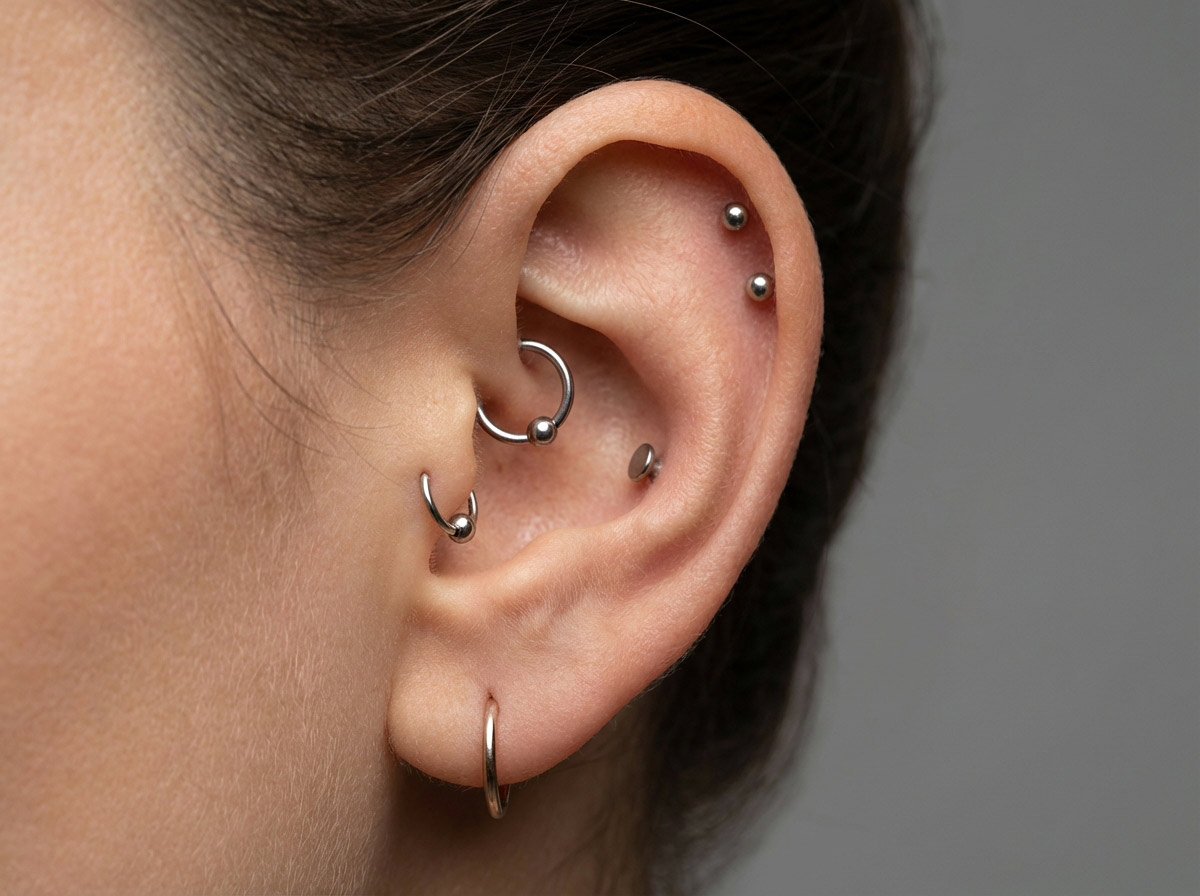
of Americans born since the mid-1970s have at least one piercing
distinct ear piercing placements — from lobe to industrial
months for cartilage piercings to fully heal internally
of ear piercings experience at least one complication — most are minor
helix is the most popular cartilage piercing — 1 in 4 cartilage piercings
Ear piercing is one of the oldest and most universal forms of body adornment — practiced across cultures for thousands of years. Today it is also one of the most searched topics online, with over 30% of Americans having at least one piercing. Whether you are considering your very first lobe piercing or planning a full curated ear stack, this guide covers everything you need to make the safest, most informed decision possible.
All Types of Ear Piercings — Complete Reference
Ear piercing is not just about the lobe anymore. There are over a dozen distinct placements across the ear, each with different healing times, pain levels, and jewelry requirements. Here is every placement you need to know:
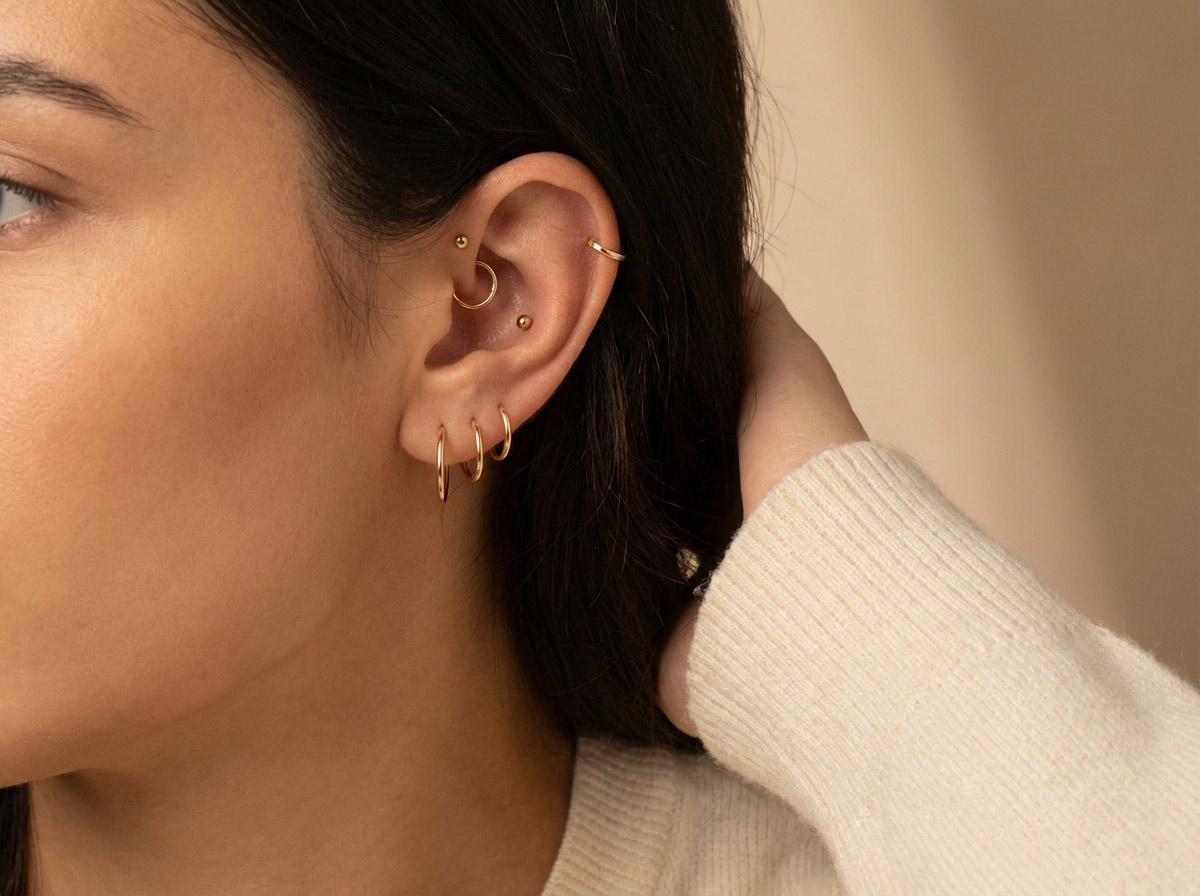
Lobe Piercings
Standard Lobe
The classic ear piercing — placed through the soft, fleshy lower portion of the ear. The most popular ear piercing in the world and the easiest to heal.
Upper Lobe
Placed slightly higher on the lobe than the standard piercing. Ideal for stacking with the standard lobe for a multi-piercing look without entering cartilage.
Stacked Lobe
Two or more piercings on the lobe placed directly on top of each other or diagonally. Driving the curated ear trend. Perfect for those not ready for cartilage.
Cartilage Piercings
Helix
Placed along the upper outer rim of the ear cartilage. The most popular cartilage piercing — approximately 1 in 4 cartilage piercings performed. Works with studs, hoops, and chains.
Hidden Helix
Placed in the inner fold of the upper cartilage, partially hidden when viewed from the front. A quiet luxury trend — dainty charms visible only from certain angles.
Double Helix
Two piercings on the same helix position, either vertically stacked or along the rim. One of the top 2025 piercing trends. Creates a bold, curated look on the upper ear.
Forward Helix
Placed on the front-facing rim of the upper ear where the ear connects to the head. Versatile and uniquely visible from the front — great for creative combinations.
Tragus
Pierced through the small, thick flap of cartilage that partially covers the ear canal. Rumored acupressure benefits for migraines. Dainty and versatile.
Daith
Passes through the innermost fold of cartilage above the ear canal. Gained massive popularity partly due to claimed migraine relief benefits — jury is still out scientifically but it looks stunning.
Conch
Placed in the large curved shell-like inner bowl of the ear. Inner conch uses a stud; outer conch uses a hoop. Offers a bold, statement canvas for larger jewelry.
Rook
Passes through the anti-helix — the inner ridge of cartilage above the daith. Anatomy-dependent (not everyone has sufficient cartilage). Unique and eye-catching.
Flat Helix
Placed in the flat upper area of cartilage below the helix rim. Anatomy-dependent. Provides a large surface for decorative statement jewelry and constellation placements.
Industrial
Two piercings connected by a single long straight barbell through the upper ear cartilage. Dramatic and edgy. Requires two healed cartilage piercings in precise alignment.
Snug
Horizontal piercing through the anti-helix ridge between the inner conch and the rim. Anatomy-dependent. Sits uniquely — different from every other placement.
Snakebite Ear
Two piercings placed close together to resemble snake fangs. Usually on the mid-helix or flat helix. One of the top 2025 trends — highly customizable with hoops, huggies, and chains.
Important: Not all placements suit all ear anatomies. Rook, snug, daith, and industrial piercings in particular are anatomy-dependent — your piercer will assess whether your ear structure will support the placement before proceeding. Never push for a placement your anatomy can't support.
Piercing Needle vs Piercing Gun — Why It Matters
This is one of the most important decisions in the piercing process. The Association of Professional Piercers (APP) and virtually all professional piercers recommend needle-only piercing. Here is the critical difference:
Piercing Needle RECOMMENDED
- Hollow needle removes a small core of tissue — creates a clean channel
- Minimal tissue trauma — faster healing with less scarring
- Single-use, disposable — fully sterile every time
- Safe for ALL ear locations including cartilage
- Allows implant-grade jewelry — not limited to starter earrings
- Performed by trained professional piercers
Piercing Gun NOT RECOMMENDED
- Forces a blunt stud through tissue — causes blunt trauma
- More tissue damage — increased swelling, scarring, complications
- Cannot be fully sterilized between clients
- Should NEVER be used on cartilage — risk of shattered cartilage
- Limited to specific starter earring designs
- Typically used at mall kiosks by minimally trained staff
Bottom line: Choose a professional piercing studio that uses hollow needles and autoclave-sterilized equipment. The extra cost compared to a mall kiosk is minimal — the difference in safety and healing outcomes is significant.
Pain Levels by Ear Piercing Type
Pain is highly individual and varies by anatomy, pain tolerance, and piercer skill. These ratings reflect consensus from professional piercers and the general piercing community — use them as a relative guide, not an absolute:
Pain tip: The actual piercing moment lasts under a second with a skilled piercer and a sharp needle. The anticipation is usually worse than the reality. Most people describe lobe piercings as a brief pinch; cartilage piercings feel like a stronger pressure followed by a dull ache for a few hours. Avoid caffeine and alcohol before your appointment, eat beforehand, and breathe steadily during the procedure.
Ear Piercing Healing Times — Full Chart
One of the most misunderstood aspects of ear piercing: piercings heal from the outside in. The surface may look and feel healed months before the internal tissue is complete. Do not change jewelry until your piercer confirms full healing.
| Piercing Type | Surface Healing | Full Internal Healing | Notes |
|---|---|---|---|
| Earlobe | 6–8 weeks | 3–6 months | Fastest healing of all ear piercings |
| Upper Lobe | 6–10 weeks | 3–6 months | Slightly thicker tissue than lower lobe |
| Helix / Flat Helix | 3–6 months | 6–12 months | Cartilage has limited blood supply — heals slowly |
| Forward Helix | 3–6 months | 6–12 months | Dense cartilage at this location |
| Tragus | 3–6 months | 6–12 months | Avoid earbuds during healing |
| Daith | 3–6 months | 6–12 months | Inner fold takes longer to fully heal |
| Conch | 3–6 months | 6–12 months | Large cartilage area — slower healing |
| Industrial | 4–6 months | 6–12 months | Two holes must heal simultaneously — high irritation risk |
| Rook | 4–6 months | 6–12 months | Dense cartilage fold — takes longer than helix |
| Snug | 4–6 months | 6–12 months | Highest rejection/migration risk of all ear piercings |
Critical rule: Never change your jewelry based on how your piercing feels. Always have your professional piercer visually confirm full healing before any jewelry change. Changing too early is one of the top causes of piercing failure, irritation bumps, and extended healing times.
Step-by-Step: What Happens During Ear Piercing
Understanding the process reduces anxiety and helps you know what to expect:
Step 1 — Consultation
Your piercer discusses placement options, assesses your ear anatomy (especially for cartilage piercings), reviews your health history, and answers questions. They will recommend the best jewelry material and style for your specific placement.
Step 2 — Setup & Sterilization
The piercer washes their hands, puts on fresh disposable gloves, and prepares a sterile field. All equipment is opened from sterile packaging. The needle is single-use and discarded after your piercing.
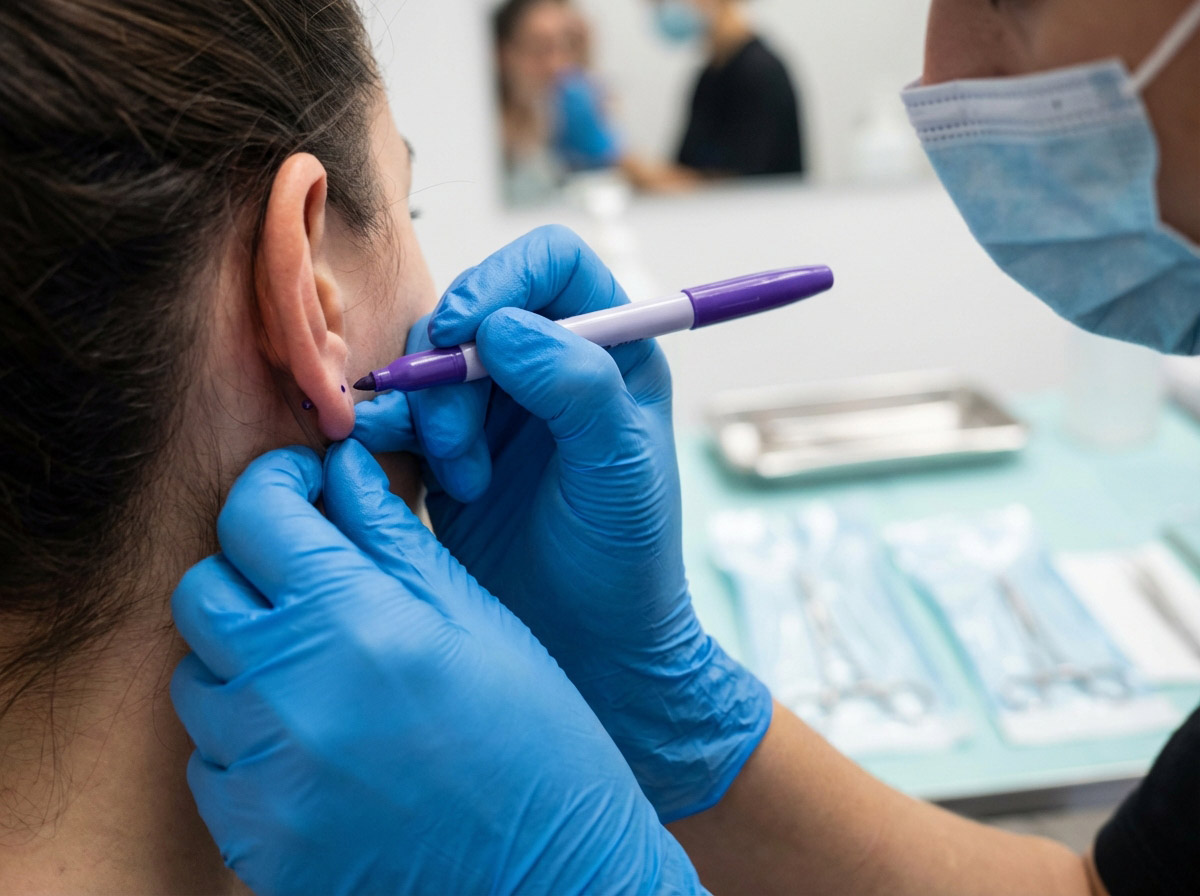
Step 3 — Marking the Placement
The piercer uses a surgical pen to mark the exact entry and exit points. You review the placement in a mirror. Always check and approve the mark before proceeding — a good piercer will adjust until you are happy.
Step 4 — The Piercing
The piercer uses a receiving tube or clamp to support the tissue and guide the needle. You will be asked to take a deep breath. On the exhale, the needle passes through in under a second. Most piercings are genuinely faster than you expect.
Step 5 — Jewelry Insertion
The initial jewelry is immediately threaded through following the needle. The threaded or threadless end is secured. The piercer checks the jewelry is properly aligned and seated. The area is gently cleaned.
Step 6 — Aftercare Instructions
Your piercer gives you written and verbal aftercare instructions. They explain the signs of normal healing vs infection, when to return for downsizing (4–6 weeks), and how long the full healing timeline is. Ask any questions now.
Ear Piercing Aftercare — Complete Instructions
Proper aftercare is the most important factor in how well your ear piercing heals. The APP aftercare guidelines are straightforward but must be followed consistently.
The Daily Routine
1 — Wash Hands
Always wash your hands thoroughly with soap and water before touching your piercing for any reason. This is non-negotiable.
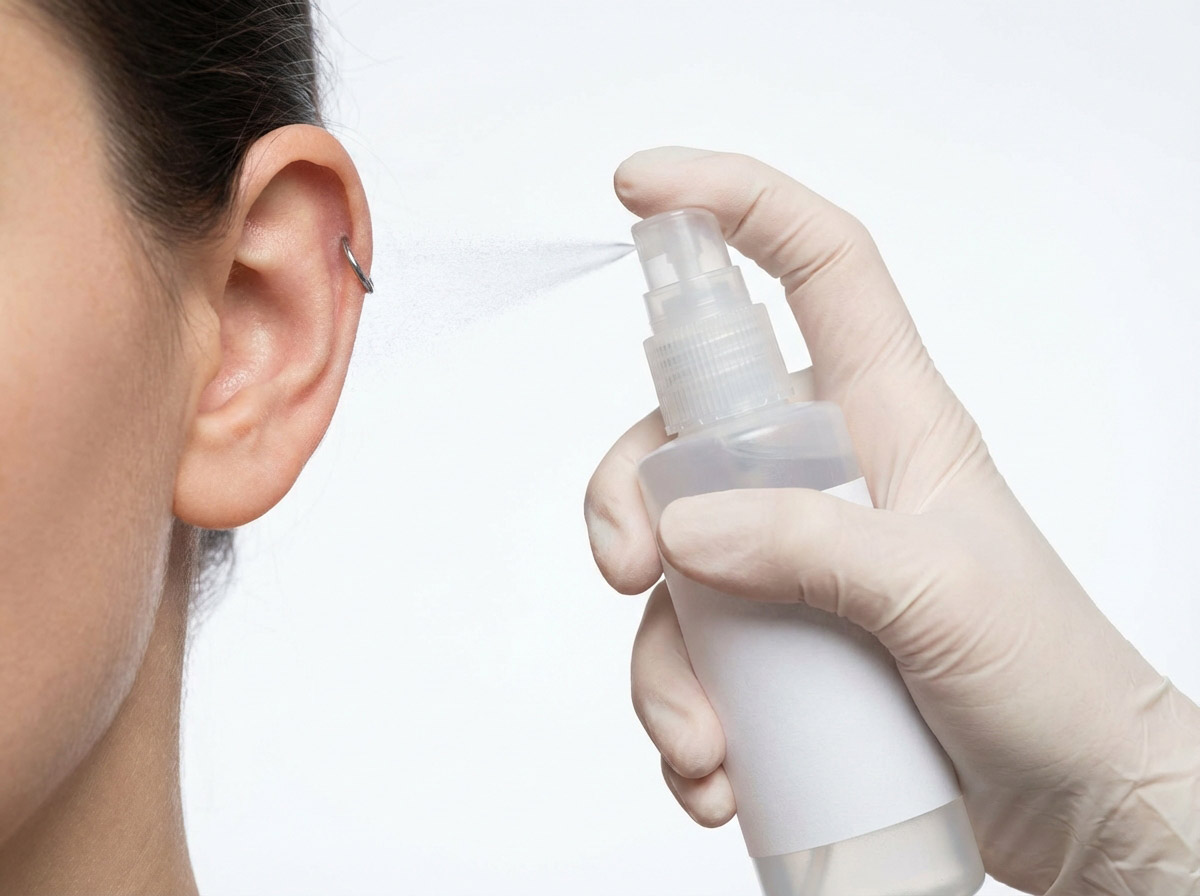
2 — Spray with Sterile Saline
Spray sterile saline wound wash (0.9% sodium chloride only — no additives) directly onto front and back of the piercing twice daily. Hold for 30–60 seconds to soften crusties. Do not rotate or move the jewelry.
3 — Pat Dry & Leave It
Gently pat dry with clean disposable gauze or paper towel. Never cloth towels. Then leave it completely alone until the next cleaning. Twice daily, every day, for the entire healing period.
DO — Healing Best Practices
- Clean twice daily with sterile saline wound wash
- Change pillowcases 2× per week — bacteria accumulate quickly
- Use a travel pillow for cartilage piercings to avoid sleeping on them
- Return at 4–6 weeks for your downsizing appointment
- Let water rinse the piercing in the shower
- Keep hair products, makeup, and perfume away from the site
- Eat well and stay hydrated — your immune system heals you
DON'T — What Slows Healing
- Never rotate or twist your jewelry — this causes micro-tears
- Don't use alcohol, hydrogen peroxide, Bactine, or antibacterial soap
- Don't swim in pools, hot tubs, lakes, or oceans during healing
- Don't change jewelry before full healing is confirmed by your piercer
- Don't over-clean — more than twice daily damages healing tissue
- Don't touch your piercing unnecessarily or allow others to touch it
- Avoid earbuds pressing on tragus/helix piercings during healing
Downsizing explained: Your initial jewelry is longer than your final jewelry to accommodate swelling. Once swelling reduces (usually 4–6 weeks), your piercer swaps it for a shorter post that fits your healed anatomy. This single step dramatically reduces irritation bumps and speeds up the rest of healing. Do not skip it.
For a full detailed aftercare guide, see our Complete Piercing Aftercare Guide. For specific saline product recommendations, see our Saline Solution Guide.
Safe Jewelry Materials for Ear Piercings
The jewelry you start with is the single most important material decision. Only APP-approved materials should be used in healing piercings:
| Material | Safety Rating | Notes | Nickel-Free? |
|---|---|---|---|
| Implant-Grade Titanium (ASTM F136) | Best Choice | Lightest, hypoallergenic, can be anodized to any color | Yes |
| 14k or 18k Solid Gold (nickel-free) | Premium Choice | Luxury aesthetic, proven biocompatibility | Yes (if nickel-free) |
| Implant-Grade Steel (ASTM F138) | Good for Most | Contains trace nickel — avoid if nickel-sensitive | No |
| Niobium | Good Option | Similar to titanium, can be anodized black | Yes |
| Sterling Silver | AVOID for New | Oxidizes in body fluids, causes permanent grey staining (argyria) | No |
| Gold-Plated Jewelry | AVOID | Plating wears off — exposes nickel base metal | No |
| Mystery / Unknown Metals | AVOID | "Surgical steel" without ASTM grade is a meaningless term | Unknown |
For a full breakdown of jewelry materials, styles, and what to look for when shopping, see our Best Jewelry for New Piercings guide.
How Much Does Ear Piercing Cost?
Ear piercing costs vary significantly by type, location, and studio quality. Here is a realistic breakdown for the USA in 2025:
Mall Kiosk / Chain
$15–$40Claire's, Piercing Pagoda / Banter, Inverness studios. Typically includes starter earrings. Gun piercing only. Lower quality but accessible. Lobe only recommended.
Professional Studio — Lobe
$30–$60Includes needle piercing + basic implant-grade jewelry. Service fee may be separate from jewelry. Best value for safety and healing outcome.
Professional Studio — Cartilage
$40–$80Helix, tragus, daith, conch, etc. Includes needle piercing + implant-grade titanium or gold starter jewelry. Pricing varies by jewelry choice.
High-End Studio — Premium Jewelry
$80–$200+Studios like Studs, Rowan, or independent high-end piercers. Includes solid 14k gold jewelry, precise placement, professional consultation.
Medical / Nurse Setting
$50–$120Rowan uses registered nurses. Blomdahl offers medical-grade piercing. Higher cost but maximum safety protocols — ideal for children and sensitive skin.
Downsizing Appointment
$15–$30Return visit at 4–6 weeks to shorten your post. Some studios include one free downsize. Do not skip this — it is critical for healing.
European pricing note: In the UK, professional studio lobe piercings typically run £20–£50. Cartilage piercings range from £30–£80. In continental Europe, pricing is broadly similar. Medical-grade piercing services (common in Germany and Scandinavia) may cost more but often include hypoallergenic medical plastic or titanium jewelry.
How to Choose a Safe Ear Piercing Studio
Not all studios are equal. These are the non-negotiable standards a reputable piercer should meet:
- APP membership or equivalent — The Association of Professional Piercers is the industry's professional standard-setter. APP members adhere to strict safety protocols.
- Uses hollow needles only — Never accepts piercing guns. Single-use disposable needles only, opened in front of you.
- Autoclave sterilization — Has and uses an autoclave (heat-pressure sterilizer) for all reusable equipment. Should be happy to show you the autoclave and spore test results.
- Implant-grade jewelry only — Stocks and uses ASTM F136 titanium, implant-grade steel, or solid 14k+ gold. Never uses mystery metals or plated jewelry for initial piercings.
- Clean, clinical environment — Clean surfaces, covered piercing bed, proper disposal of sharps. Piercer wears fresh gloves for every client.
- Takes time for consultation — Assesses your anatomy, discusses options, answers questions, and marks the placement before proceeding.
- Provides written aftercare — Always provides clear written aftercare instructions. Is available for follow-up questions.
- Checks ID for minors — Requires parental consent and presence for clients under 18. This is a sign of a responsible, legitimate business.
Where to find reputable piercers: Use the APP member search tool to find APP-certified piercers near you. In the USA, chains like Studs and Rowan (nurse-performed) also maintain high standards. Always read reviews specifically mentioning healing outcomes, not just aesthetic results.
Ear Piercing for Children — Safety Guide
Ear piercing for children is a common cultural practice, but it requires specific safety considerations. Here is what the medical community and professional piercers recommend:
Recommended Age
The American Academy of Pediatrics (AAP) generally recommends waiting until children are old enough to care for the piercing themselves. For very young children, most physicians recommend waiting until at least 2 months of age (after first vaccinations) to minimize infection risk in infants.
Key Safety Rules
- Parental presence required during the procedure
- Hypoallergenic jewelry only — titanium or 14k gold preferred
- Screw-back closures reduce choking hazard risk in small children
- Nurse-piercing services (Rowan, Blomdahl) are ideal for children
- Monitor closely — about 35% of piercings develop minor complications
Warning Signs in Kids
Contact your pediatrician if you notice: redness spreading beyond the piercing, any discharge that is yellow or green, fever, the earring back appearing embedded in the skin, or pain that worsens rather than improving. Infections from ear piercings can lead to hospitalization of very young children if not treated promptly.
Complications & Warning Signs
According to medical research, approximately 35% of ear piercings experience at least one complication — but the vast majority are minor and manageable. Here is what to watch for:
| Issue | What It Looks Like | Action |
|---|---|---|
| Normal Healing | Mild redness, clear/white discharge (crusties), mild tenderness improving over time | Continue aftercare — this is normal |
| Irritation Bump | Small soft bump at piercing site, usually caused by poor jewelry or trauma | Switch to implant titanium, downsize post — see our bump guide |
| Allergic Reaction | Itching, rash, persistent redness, especially from metal contact | Switch to implant-grade titanium immediately |
| Infection (Minor) | Increasing redness, warmth, thicker discharge, mild worsening | Improve aftercare — see doctor if not improving in 3–5 days |
| Infection (Serious) | Spreading redness, green/yellow pus, fever, red streaks | See a doctor immediately |
| Keloid | Firm growth extending BEYOND the piercing hole, continues growing | See a dermatologist — see our keloid guide |
| Rejection / Migration | Jewelry appears to be moving, skin over piercing thinning | See your piercer immediately — may need to remove |
| Embedded Jewelry | Backing or end sinking into the skin due to swelling | See your piercer or doctor — do not attempt removal yourself |
For full details on infection signs and treatment, see our Piercing Infection Guide.
The Curated Ear & Earscape Trend
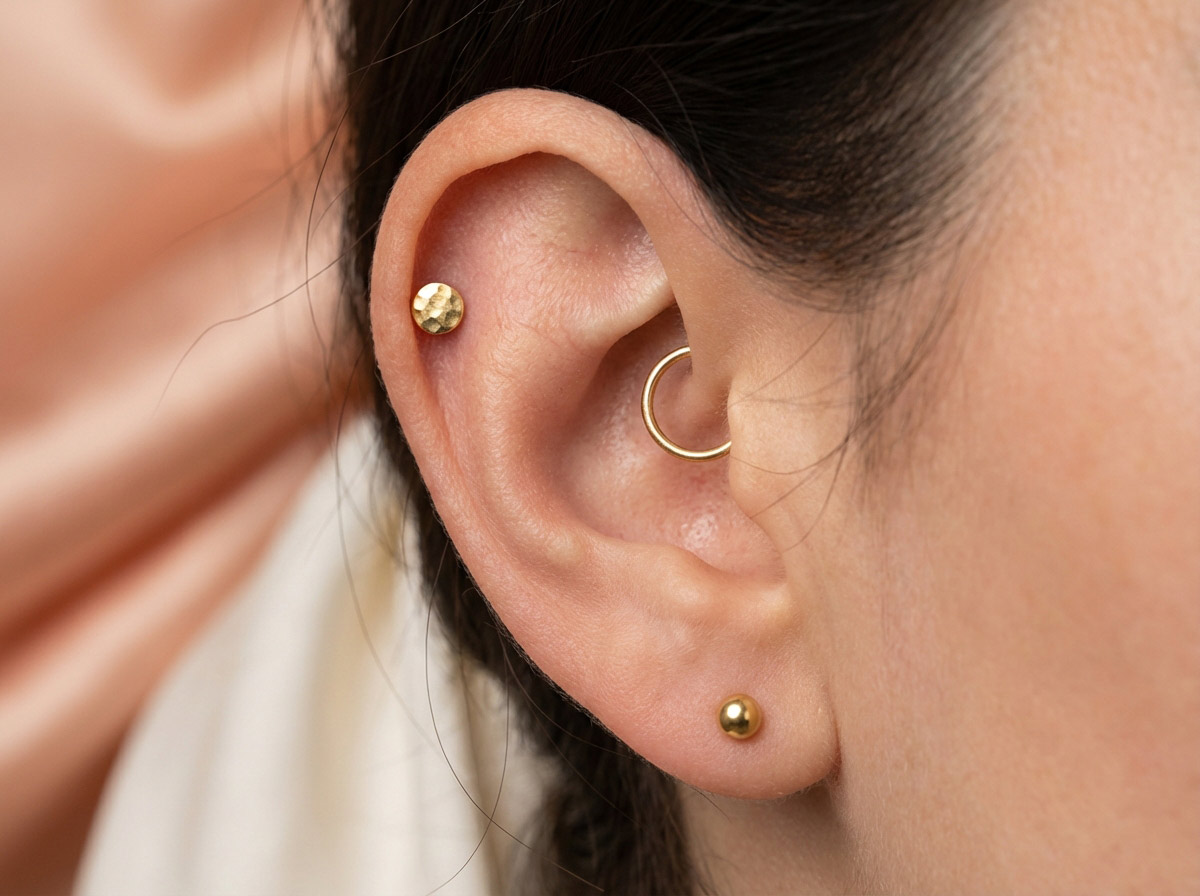
The single biggest shift in ear piercing culture over the last two years is the curated ear (also called "earscaping") — the intentional design of multiple piercings across the ear as a unified, styled composition rather than random individual piercings.
Instead of one helix or one lobe piercing, people are designing full ear galleries — combining 5, 6, or 8+ carefully placed piercings with coordinated jewelry to create a unique personal look. Brands like Studs and Rowan have made this into a full service offering.
2025 Hottest Styles
- • Hidden helix — quiet luxury
- • Double helix stack
- • Snakebite ear placement
- • Stacked lobes (3+ piercings)
- • Constellation lobe placement
Trending Jewelry Styles
- • Flat-back studs with gem tops
- • Pearl earrings (safe for winter)
- • Chain connections between piercings
- • Minimalist gold huggies
- • Dainty charms and dangles (healed)
Planning Your Curated Ear
- • Plan full layout before starting
- • Don't get more than 3–4 at once
- • Allow each to fully heal before stacking
- • Consult an experienced piercer for placement
- • Keep records of healing stages
Frequently Asked Questions
How much does ear piercing cost?
Prices vary by venue type. Mall kiosks charge $15–$40 including starter earrings. Professional piercing studios charge $30–$60 for lobe piercings and $40–$80 for cartilage. High-end studios with premium solid gold jewelry can reach $80–$200+. In the UK, expect roughly £20–£80 depending on type and studio. Always factor in the cost of a downsizing appointment at 4–6 weeks ($15–$30).
Does ear piercing hurt?
Lobe piercings are rated around 2/10 for pain — a very brief pinch under a second. Cartilage piercings rate 4–6/10 — a sharper sensation due to the density of cartilage, followed by mild throbbing for a few hours. A skilled piercer using a sharp hollow needle makes the process significantly less painful than a gun. Most people find the anticipation worse than the actual piercing.
How long does ear piercing take to heal?
Earlobes heal on the surface in 6–8 weeks but take 3–6 months for full internal healing. All cartilage piercings (helix, tragus, daith, conch, industrial, rook) take 6–12 months for full healing. Piercings heal outside-in — the surface feels fine long before the inside is complete. Never change jewelry until your professional piercer confirms full healing.
What is the safest jewelry for a new ear piercing?
Implant-grade titanium (ASTM F136) is the safest choice — completely nickel-free, hypoallergenic, and biocompatible. 14k or 18k solid gold (nickel-free) is the premium alternative. Both are APP-approved for initial piercings. Avoid sterling silver, gold-plated jewelry, mystery metals, and any piece without a verified ASTM grade certification.
At what age can you get your ears pierced?
There is no universal US minimum age. Most states require parental consent for minors under 18. Medically, the AAP recommends waiting until children can participate in their own aftercare. For infants, most physicians recommend waiting until at least 2 months of age (after first vaccinations). Most reputable professional studios will not pierce anyone under 16 without parental presence and signed consent.
Is it better to get ears pierced with a needle or a gun?
A piercing needle is significantly better and safer than a gun. Hollow needles create a clean channel with minimal trauma and are fully sterile (single-use). Piercing guns use force to push a blunt stud through tissue causing more trauma, cannot be fully sterilized, and should never be used on cartilage. The APP recommends needle-only piercing for all placements.
What is the most popular ear piercing?
By total volume, the standard earlobe piercing is the most popular globally. Among cartilage piercings, the helix is #1 — accounting for approximately 1 in 4 cartilage piercings performed. Other highly popular piercings in 2025 include the daith, tragus, conch, flat helix, and stacked lobes. The hidden helix and double helix are among the fastest-growing trends of 2025.
Can I get an ear piercing with a nickel allergy?
Yes — but you must insist on implant-grade titanium (ASTM F136) or solid nickel-free 14k+ gold. Both are completely nickel-free and safe for nickel-sensitive individuals. Avoid implant-grade steel (contains trace nickel), sterling silver, gold-plated, and any unverified metal. Tell your piercer about your allergy at the start of your consultation.
Have a question about ear piercing?
Drop it in the comments — we answer every one!