
Piercing Jewelry · Complete Guide · 2025
Best Jewelry for New Piercings:
Materials, Styles & What to Avoid
The jewelry you start with determines how well — and how fast — your piercing heals. This complete guide covers every safe material, the right style by piercing type, and exactly what never to wear on a fresh piercing.
Most people focus on where to get pierced and what design they want — but the single most important decision you make for your piercing's success is what material it's made of. The right jewelry heals beautifully. The wrong jewelry causes infections, irritation bumps, and prolonged healing that can last years.
Why Your Jewelry Choice Determines Everything
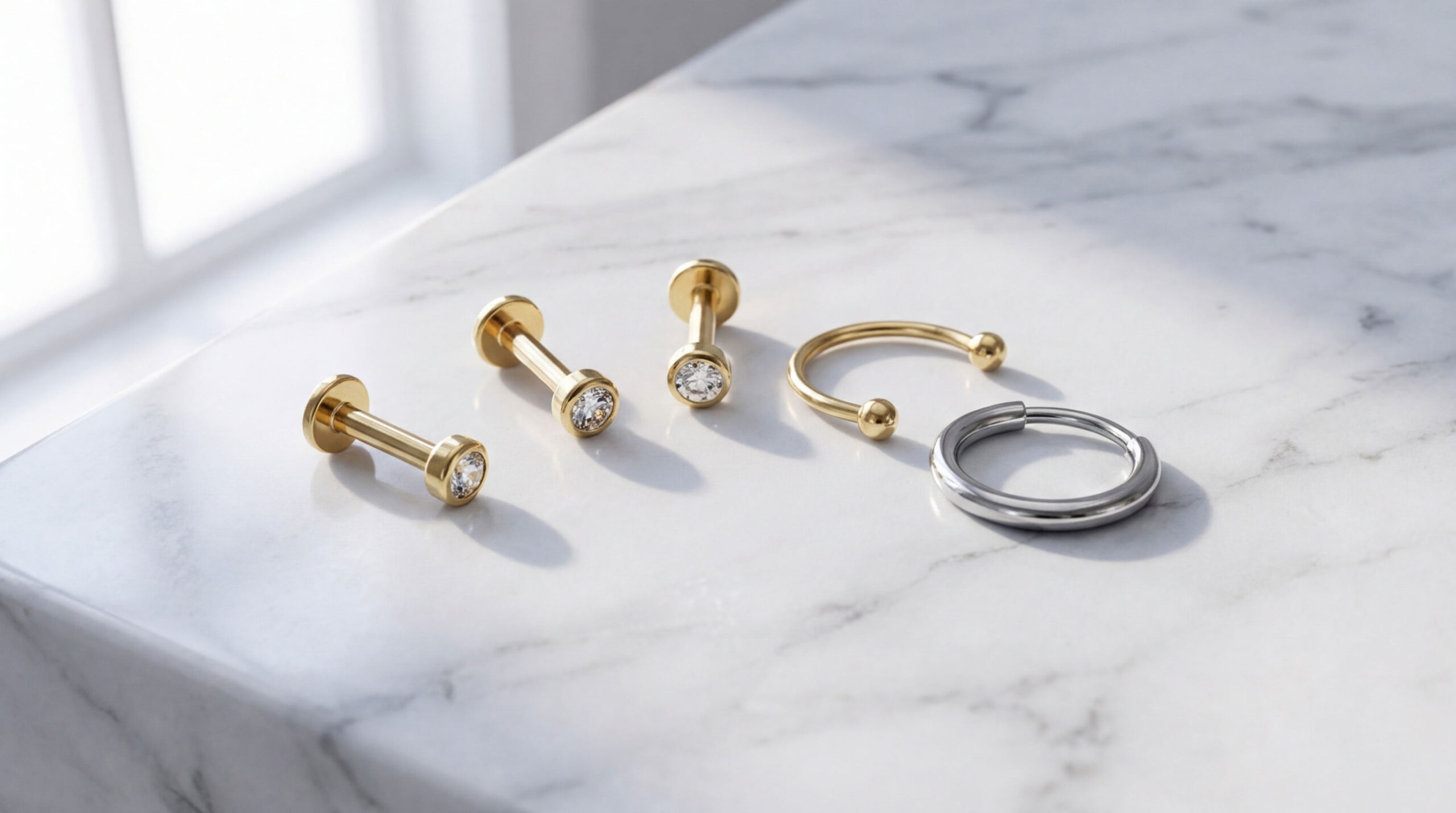
According to the Association of Professional Piercers (APP) — the gold standard authority on piercing safety — the material, size, style, and quality of your initial jewelry all directly affect your ability to heal. The piercing location is fixed, but the jewelry is not — which is why getting it right from the start matters so much.
A new piercing is an open wound. The jewelry sits inside that wound, in direct contact with your body's internal healing tissue, 24 hours a day for months. Any material that is reactive, porous, rough, or contains allergens like nickel will continuously irritate that tissue — preventing proper healing, causing inflammation, and dramatically increasing infection risk.
This is also why professional piercers use specific, certified jewelry grades — not the jewelry sold in mall kiosks, beauty supply stores, or most online marketplaces. The body jewelry industry is, as the APP notes, "saturated with substandard products." Price alone is never the right guide.
The APP's core standard: Jewelry worn in a healing piercing must be able to withstand autoclave sterilization AND be inert and compatible with the body — so it doesn't cause irritation, allergy, or infection. Only a handful of materials meet both criteria.
What Makes Piercing Jewelry Safe?
Before getting into specific materials, it helps to understand the three core criteria that make any material appropriate for a healing piercing:
Biocompatible
The material must be biologically inert — meaning it doesn't react with your body's tissues, trigger immune responses, or leach chemicals into the wound. Certified by ASTM or ISO standards.
Autoclave Sterilizable
The material must withstand the heat and pressure of autoclave sterilization — the gold standard for eliminating all pathogens including bacterial spores. Materials that degrade under autoclave conditions (like some plastics) cannot be properly sterilized.
Smooth, Non-Porous Surface
Porous surfaces trap bacteria and debris. Textured, threaded, or rough surfaces inside the piercing channel cause micro-tears during normal movement. Smooth, polished surfaces are critical — which is why internally threaded or threadless jewelry is preferred over externally threaded pieces.
Best Jewelry Materials — Ranked
These are the only materials approved by the Association of Professional Piercers for use in initial (healing) piercings:
Implant-Grade Titanium
The unanimous #1 recommendation from professional piercers worldwide. Titanium is completely nickel-free, hypoallergenic, lightweight, corrosion-resistant, and fully biocompatible. It can be anodized to produce a wide range of colors without any coatings or chemicals — the color is produced through controlled oxidation, which is completely safe.
14k or 18k Solid Gold
Solid gold has been used in piercings for thousands of years — the APP approves it at 14k or higher, provided it's nickel-free and cadmium-free and alloyed for biocompatibility. Yellow, rose, and white gold are all acceptable if these criteria are met.
Implant-Grade Steel
Implant-grade surgical steel is safe for most people — but it does contain a small amount of nickel (which is locked in the alloy and shouldn't leach under normal conditions). People with significant nickel allergies should choose titanium or solid gold instead.
Niobium
Very similar to titanium in properties — nickel-free, hypoallergenic, and can be anodized to produce colors (including black, unlike titanium). Professional piercers have used it successfully for decades. No implant-grade certification exists, but it performs comparably to titanium.
Implant-Grade Glass
High-quality implant glass is completely non-porous, smooth, and biocompatible. However, it's fragile — not ideal for active people or piercings prone to snagging. Best for healed piercings or specialist use. Must be implant-grade; standard glass is not suitable.
Certification to look for: When buying titanium jewelry, check for "ASTM F136" on the product listing. When buying gold, confirm it's "solid 14k or 18k" and "nickel-free." These aren't marketing terms — they're engineering standards. If a seller can't confirm the grade, don't buy for a fresh piercing.
Materials to Absolutely Avoid for New Piercings
These materials are commonly sold but are inappropriate for healing piercings. Many cause persistent irritation that gets mistaken for infection — and some cause permanent skin damage.
Sterling Silver
The most dangerous common misconception. Silver oxidises in contact with body fluids, and the tarnish can be permanently absorbed into skin — causing argyria, a grey-blue permanent discolouration of the piercing site. Never use for new or healing piercings.
Gold-Plated / Gold-Filled
The plating wears away over days or weeks, exposing the base metal underneath — which is almost always nickel-containing. This causes allergic reactions, chemical irritation, and dramatically slows healing. Only solid gold is acceptable.
Mystery / Unknown Metals
"Surgical steel," "hypoallergenic," and "stainless steel" without specific ASTM certification are meaningless marketing terms. The grade matters enormously — never use jewelry with unverified metal composition in a fresh piercing.
Acrylic / Plastic
Acrylic and most plastics cannot be autoclaved, are porous (harbor bacteria), and degrade over time releasing chemicals into the wound. Not appropriate for initial piercings under any circumstances.
Nickel-Containing Alloys
Nickel is the #1 metal allergen. Even trace amounts cause prolonged inflammation in sensitive individuals. Avoid any jewelry that doesn't explicitly state "nickel-free." Most cheap fashion jewelry contains nickel.
Externally Threaded Jewelry
External threads — where the screw pattern is on the outside of the bar that passes through the tissue — are sharp and rough. Every time you insert or remove the jewelry, those threads drag across your healing tissue. Always choose internally threaded or threadless pieces.
Best Jewelry Styles for New vs Healed Piercings
Material is only half the decision — the style of jewelry matters too. Some styles actively support healing; others create problems from day one.
Flatback Labret Stud
The #1 recommended style for most initial piercings. A flat disc back sits flush against the skin — no pressure, no snagging, minimal movement. The decorative top is threadless or internally threaded. Best for: lobes, helix, tragus, conch, nose, lip.
Straight Barbell
Standard for tongue and nipple piercings. Sized longer than the final jewelry to accommodate initial swelling — downsized after 2–4 weeks. Internally threaded or threadless only.
Curved Barbell
The banana barbell is standard for navel piercings and eyebrow surface piercings. The curve follows the body's contour, reducing pressure on the exit points. Must be appropriately sized for swelling.
Circular / Horseshoe Barbell
Used for septum piercings initially — can be flipped up to hide during healing. Also suitable for some genital piercings. The open circle design doesn't apply constant pressure.
Rings & Hoops
Hoops are not suitable for initial piercings — they rotate constantly with normal movement, disrupting the healing fistula channel and introducing bacteria. Only introduce hoops after full healing is confirmed.
Clicker / Hinged Ring
A hinged ring with a click closure — generally introduced after initial healing for piercings like daith, rook, and septum. Some styles are appropriate for healed piercings only; your piercer will advise.
Threadless (Push-Pin) System
The decorative top is secured by a bent post that clips into the flatback — no threads anywhere. Popular with premium piercing studios. Extremely smooth insertion reduces tissue trauma. Excellent for initial piercings.
Chains & Dangles
Chains, charms, and dangling elements are only safe for fully healed piercings. They move too much during healing and create constant mechanical irritation. A major 2025 trend — but wait until healed.
Internally threaded vs threadless: Both are excellent. Internally threaded means the screw is inside the decorative top (not on the bar that passes through tissue). Threadless means no screw at all — a bent wire clips the top into the flatback. Both are smooth on the surface that contacts your healing tissue. Externally threaded jewelry — where the screw is on the bar — should never be used for initial piercings.
Best Jewelry by Piercing Type — Reference Chart
Every piercing has a specific ideal initial jewelry style and gauge. Use this chart as a starting point — your professional piercer will confirm the exact sizing based on your anatomy:
| Piercing | Best Style | Best Material | Typical Gauge |
|---|---|---|---|
| Earlobe | Flatback labret stud | Implant titanium / 14k gold | 20g or 18g |
| Helix | Flatback labret stud | Implant titanium / 14k gold | 16g or 18g |
| Forward Helix | Flatback labret stud (small) | Implant titanium | 16g or 18g |
| Flat / Flat Helix | Flatback labret stud | Implant titanium | 16g |
| Conch (inner) | Flatback labret stud | Implant titanium / 14k gold | 16g |
| Conch (outer) | Flatback labret stud or ring (healed) | Implant titanium / 14k gold | 16g |
| Tragus | Flatback labret stud | Implant titanium / 14k gold | 16g or 18g |
| Daith | Curved barbell or ring (healed) | Implant titanium / 14k gold | 16g |
| Rook | Curved barbell | Implant titanium | 16g |
| Industrial | Straight barbell (longer for swelling) | Implant titanium | 14g |
| Nostril | Flatback labret stud or L-shape | Implant titanium / 14k gold | 18g or 20g |
| Septum | Circular barbell (horseshoe) | Implant titanium / 14k gold | 16g or 14g |
| Bridge | Straight barbell (surface bar) | Implant titanium | 14g |
| Eyebrow | Curved barbell | Implant titanium | 16g |
| Navel | Curved barbell (banana) | Implant titanium / 14k gold | 14g |
| Nipple | Straight barbell | Implant titanium / 14k gold | 14g |
| Tongue | Straight barbell (longer for swelling) | Implant titanium / implant steel | 14g |
| Lip / Labret | Flatback labret stud | Implant titanium / 14k gold | 16g or 14g |
| Medusa / Philtrum | Flatback labret stud | Implant titanium / 14k gold | 16g |
| Dermal / Microdermal | Flat-disc anchor + decorative top | Implant titanium | 14g or 16g |
Gauge and style will be determined by your piercer based on your anatomy, skin thickness, and the specific placement. These are general starting points only.
Jewelry Sizing & Gauge — Why It Matters
Choosing the right size is just as critical as choosing the right material. Jewelry that's too short embeds in swelling tissue. Jewelry that's too long snags constantly and creates irritation bumps. Your piercer will select the correct size — but understanding the basics helps you follow their guidance.
Gauge (Thickness)
Gauge refers to the thickness of the jewelry bar. In the US system, lower gauge = thicker. Standard lobe piercings are typically 18g or 20g. Cartilage piercings range from 14g to 18g. Tongue and navel are usually 14g. Never try to insert a larger gauge than what you were pierced with — this is called upsizing and must be done by a piercer.
Length / Diameter
Initial jewelry is always longer than the final size to accommodate swelling. A flatback post is typically 6–8mm for initial piercings, downsized to 4–6mm once swelling resolves (usually at 4–6 weeks). The exact length depends on your anatomy — your piercer measures this specifically for you.
End / Top Size
The decorative top (gem, ball, flat disc) should be large enough to not sink into the piercing but small enough to not create excessive pressure. Most professional initial piercings use 2mm–4mm tops. Oversized tops pull and rotate, which delays healing.
Never cut corners on sizing. A jewelry post that is 1mm too short can embed in tissue during the swelling phase — a complication that requires professional removal. Your piercer's sizing judgment is based on direct measurement of your anatomy. Trust it.
New Piercings vs Healed Piercings — What Changes?
Many people don't realize that the rules for jewelry change significantly once a piercing is fully healed. Here's what opens up:
New / Healing Piercings
- Implant-grade titanium ASTM F136
- 14k or 18k solid gold (nickel-free)
- Implant-grade steel ASTM F138
- Niobium
- Flatback labret studs / straight barbells
- Internally threaded or threadless only
- No rings / hoops
- No silver, plated, or fashion jewelry
- No dangles, chains, or charms
Fully Healed Piercings
- All safe initial materials, still preferred
- Sterling silver (carefully, with monitoring)
- Gold-plated over solid gold base
- Rings, hoops, and clicker rings
- Chains, charms, and dangles
- Larger decorative tops and ends
- Fashion jewelry (monitor for reactions)
- Still avoid mystery metals or unknown alloys
- Still avoid nickel if you're sensitive
Downsizing — The Most Overlooked Step
Downsizing is one of the most important and most overlooked parts of the piercing journey. It means returning to your piercer 4–6 weeks after your initial piercing to swap the starter jewelry for a shorter post — once the initial swelling has gone down.
Why Downsizing Is Critical
Initial jewelry is deliberately longer than your final jewelry to accommodate the swelling that occurs in the first few weeks. Once swelling reduces, that extra length becomes a problem: the long post moves around with every touch, snags on hair and pillowcases, and creates the mechanical irritation that causes those notorious irritation bumps.
A properly downsized piece — fitted precisely to your anatomy at that stage of healing — dramatically reduces irritation, speeds up healing, and prevents the endless cycle of bump-treatment that plagues so many piercings unnecessarily.
When to Downsize
4–6 weeks after initial piercing for most placements. Your piercer will assess the swelling and confirm.
Who Should Do It
Your professional piercer — never attempt to change jewelry yourself in a healing piercing.
What Changes
Post length reduces — same material and style, just properly fitted to your healing piercing.
The Result
Dramatically reduced irritation. Bumps resolve. Healing speeds up significantly.
Shopping Tips & Red Flags to Watch For
The online body jewelry market is flooded with low-quality products using misleading terminology. Here's how to shop safely:
Green Flags — Buy With Confidence
- Lists specific ASTM or ISO certification (F136, F138)
- Sold by or stocked in professional piercing studios
- States "internally threaded" or "threadless" system
- Can provide mill certificates on request
- Trusted brands: Anatometal, Neometal, Junipurr, Buddha Jewelry, BVLA
- Explicitly states "nickel-free" (not just "hypoallergenic")
Red Flags — Avoid
- "Surgical steel" without ASTM grade specified
- "Hypoallergenic" without specifying the actual metal
- "Gold-tone" or "gold-colored" — almost always plated
- Sold in bundles of 20+ pieces for $10 — impossible quality at that price
- External threads visible on the bar
- No return policy — quality brands stand behind their products
Best approach for initial jewelry: Let your professional piercer select and supply your initial jewelry. Professional piercing studios source from certified suppliers, and the jewelry is autoclaved before insertion. The jewelry cost is almost always included in or offered at the time of your appointment — this is the safest and most reliable route.
Frequently Asked Questions
What is the best material for a new piercing?
Implant-grade titanium (ASTM F136) is the #1 recommendation from professional piercers worldwide. It is completely nickel-free, hypoallergenic, lightweight, corrosion-resistant, and can be anodized to different colors safely. 14k or 18k solid gold (nickel-free) is the premium alternative — both are approved by the Association of Professional Piercers (APP).
Can I use sterling silver in a new piercing?
No — never use sterling silver in a new or healing piercing. Silver oxidises when exposed to body fluids, and the tarnish can be permanently absorbed into the skin, causing argyria — a grey-blue permanent discolouration. Sterling silver is only appropriate for fully healed piercings and even then with caution and regular cleaning.
What is the best jewelry type for a new ear piercing?
A flatback labret stud (threadless or internally threaded) in implant-grade titanium or 14k solid gold is the best starter jewelry for most ear piercings — including lobe, helix, tragus, conch, and most cartilage piercings. The flat back sits flush against the skin, reduces pressure, and doesn't snag. Hoops and rings should only be introduced after full healing.
What does ASTM F136 mean?
ASTM F136 is the American Society for Testing and Materials standard for implant-grade titanium (Ti6Al4V ELI). It certifies that the titanium meets precise standards for purity, composition, and biocompatibility — making it safe for use inside the body during the healing process. When buying titanium piercing jewelry, this is the certification you want to see listed.
Is surgical steel safe for new piercings?
Only if it's implant-grade surgical steel with ASTM F138 certification. "Surgical steel" without a specific grade is a meaningless marketing term. Implant-grade steel (316LVM, ASTM F138) is safe for most people, but it does contain trace amounts of nickel — so people with nickel sensitivities should choose implant-grade titanium or solid gold instead.
Can I wear hoops in a new piercing?
No — hoops and rings are not suitable for initial piercings. They rotate with every movement — sleeping, touching your ear, changing clothes — which disrupts the healing fistula channel and introduces bacteria from the outer surface into the wound. Studs and flatbacks keep the jewelry stable. Introduce hoops only after your piercer confirms full healing.
When can I change my piercing jewelry?
Only after your piercing is fully healed internally — not just when it looks or feels fine on the surface. This ranges from 3–6 months for earlobes to 6–12 months for cartilage piercings. You should visit your piercer for a downsizing appointment at 4–6 weeks and have them confirm full healing before any jewelry change. Changing too early is one of the most common reasons piercings fail.
Related Reading
Questions about your piercing jewelry?
Drop them in the comments — we answer every one!