
Complete Guide · Helix Piercing · 2026
Helix Piercing:
The Complete Guide for 2026
Everything about helix piercing — all six types, pain level, healing timeline, best jewelry, aftercare, cost, and why the helix is the #1 cartilage piercing in the world.
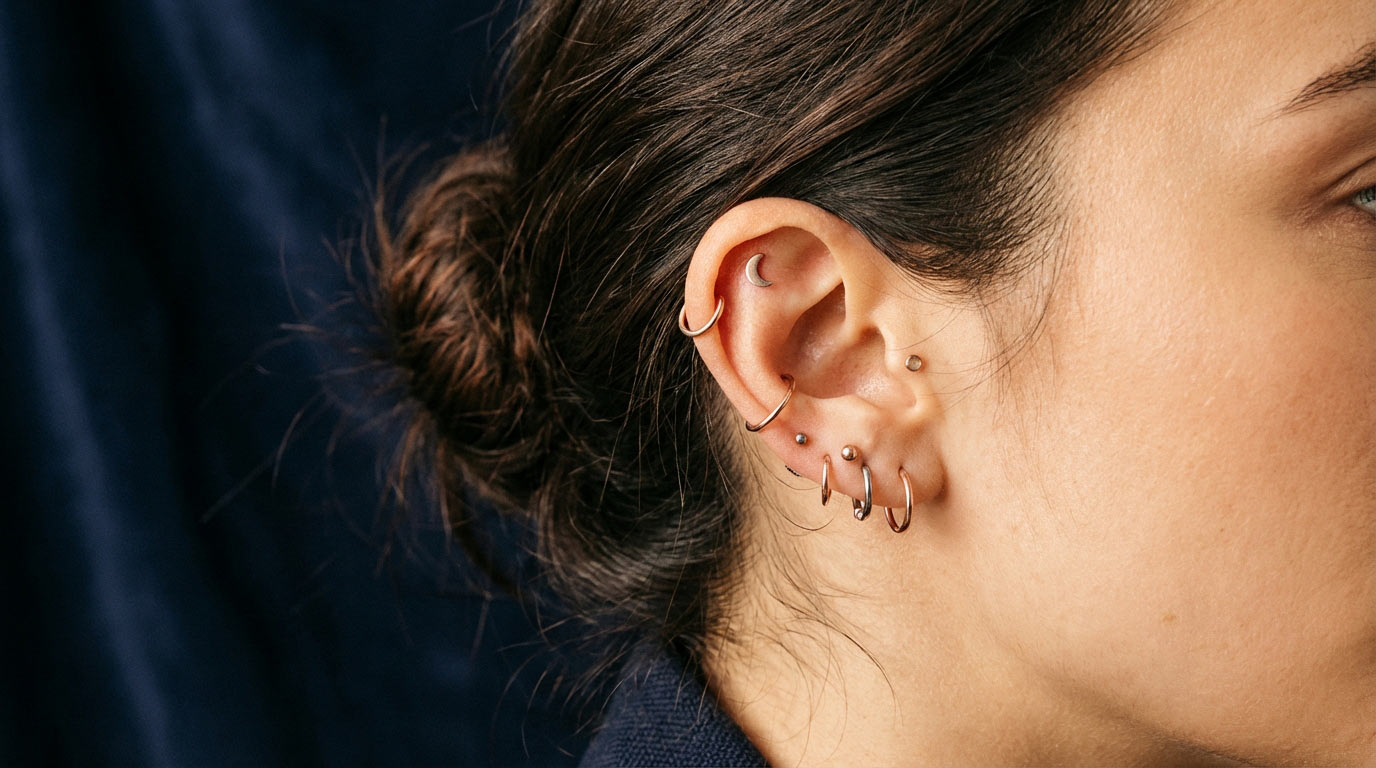
Most popular cartilage piercing globally
Cartilage piercings performed is a helix
Pain rating — least painful cartilage placement
Distinct helix variations to choose from
Standard gauge for helix piercings
The helix piercing is the world's most popular cartilage piercing — and for good reason. It is the least painful cartilage placement, heals well for a first cartilage piercing, and offers more jewelry flexibility than almost any other ear piercing. Whether you want a single dainty stud or a full double helix stack, this guide covers everything.
What Is a Helix Piercing?
A helix piercing is any piercing placed through the upper cartilage rim of the ear — the curved outer ridge that forms the top and back of the ear. The word “helix” refers to this spiral-shaped cartilage rim itself. It is the most accessible part of ear cartilage, sitting on the outer edge where the cartilage is thinner and has fewer nerve endings than inner-ear placements like the tragus, daith, or rook.
This anatomy is precisely why the helix is the recommended first cartilage piercing: thinner cartilage at the rim means less resistance for the needle, less pain, and generally faster healing compared to deeper cartilage placements. It is also the most versatile location for jewelry — from tiny flat-back studs to dramatic hoops, chains, and stacked combinations.
The helix accounts for approximately one in four cartilage piercings performed worldwide, and in 2026 its many variations — hidden helix, double helix, flat helix, forward helix — are driving the curated ear aesthetic that dominates piercing culture.
Good first cartilage piercing? Yes — the standard helix is the #1 recommendation for anyone stepping up from lobe piercings. Lower pain, accessible location for cleaning, good healing prognosis, and maximum jewelry versatility once healed.
All 6 Helix Piercing Types Explained
The helix is not a single placement — it is a family of related piercings along the cartilage rim. Here are all six variations:
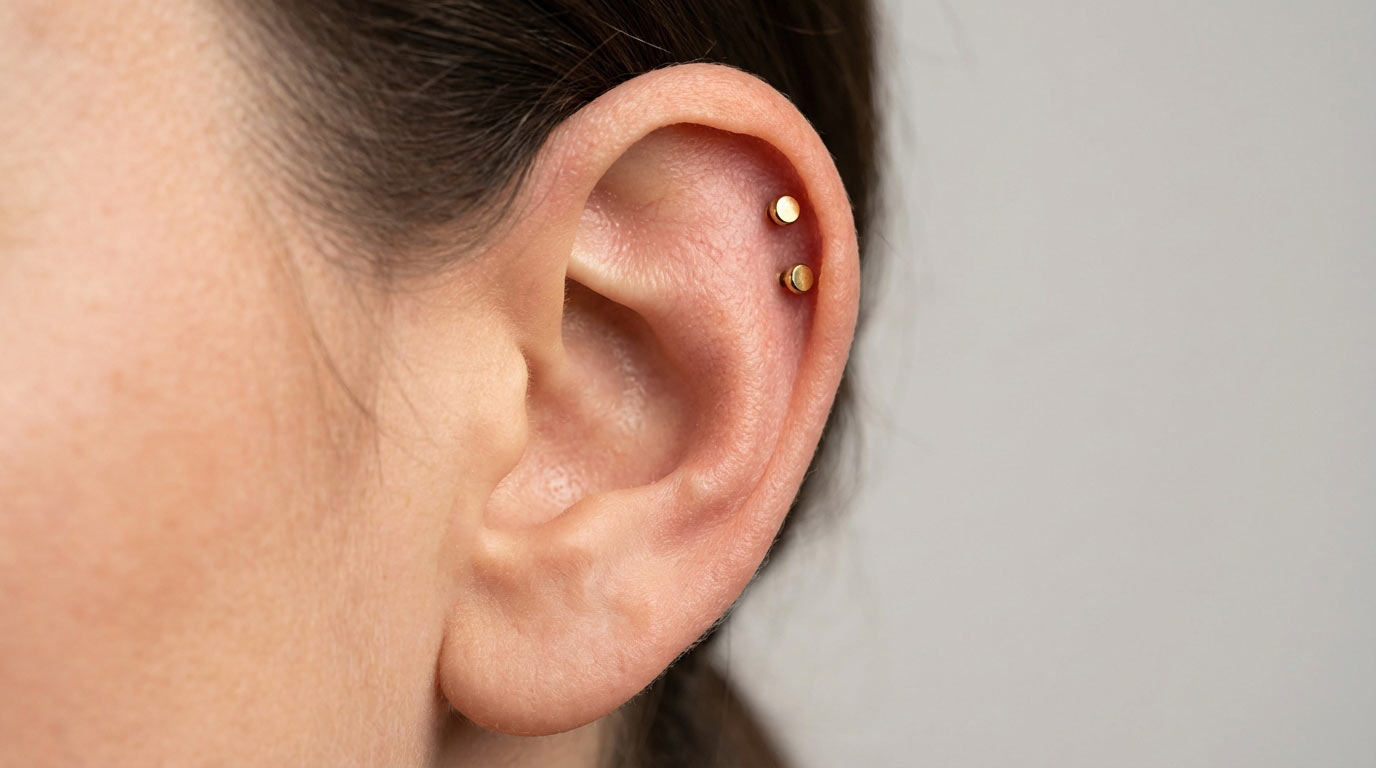
Standard Helix
Placed along the upper outer cartilage rim — the most common helix placement. Works on almost all ear anatomies. The go-to first cartilage piercing. Beautiful with studs, hoops, and chains once healed.
Double Helix
Two piercings on the same helix rim — stacked vertically or spaced along the curve. The most in-demand cartilage combination of 2026. Both piercings heal independently and can be styled with matched or mismatched jewelry.
Triple Helix
Three piercings along the helix rim. Dramatic and eye-catching — typically spaced evenly up the curve. Best planned with your piercer in one session for precise alignment. Spacing piercings 2–3 apart ensures they don't interfere with healing.
Hidden Helix
Placed in the inner fold of the helix, partially concealed when viewed front-on. The “quiet luxury” cartilage piercing — a dainty charm glints subtly when you turn your head. The fastest-growing placement of 2026 by piercer reports.
Forward Helix
Placed on the front-facing rim where the ear meets the head — directly forward-facing, highly visible from the front. Slightly more anatomy-dependent than the standard helix. Great for pairing with a tragus for a front-of-ear cluster.
Flat Helix
Placed in the large flat panel of cartilage below the helix rim (the scapha). Anatomy-dependent — flat panel size varies. Provides a wide canvas for decorative statement jewelry. Popular for constellation-style placements.
How Much Does a Helix Piercing Hurt?
The helix is the least painful cartilage piercing — a 4/10 compared to a 2/10 for earlobes. The outer rim has fewer nerve endings than inner-ear placements. Here is how it compares to other cartilage piercings:
What to expect: A sharp pressure sensation as the needle passes through (under one second), then mild throbbing and warmth for 2–4 hours. Mild soreness when touched or accidentally bumped may last a few days. Most people are surprised how quickly it is over.
Helix Piercing Healing Times
Helix piercings heal faster than most other cartilage piercings due to their accessible outer-rim position — but they still require 6–12 months for full internal healing. The surface appearing healed does not mean the internal channel is complete.
| Milestone | Timeline | What to Do |
|---|---|---|
| Initial tenderness resolves | 1–2 weeks | Continue saline cleaning twice daily |
| Visible swelling reduces | 2–4 weeks | Book your downsizing appointment |
| Downsizing appointment | 4–6 weeks | Critical — swap long post for shorter fitted post |
| Surface healed (feels fine) | 3–4 months | Continue saline — do NOT change jewelry yet |
| Earliest jewelry change | 4–6 months | Piercer confirms healing before any change |
| Full internal healing | 6–12 months | Jewelry change safe — explore hoops and chains |
The downsizing appointment is the most important step most people skip. The initial 6–8mm post is deliberately long to accommodate swelling. Once swelling reduces, that extra length snags constantly on hair, pillowcases, and headphones — directly causing the bumps that plague so many helix piercings. A properly downsized 4–6mm post at week 4–6 resolves the vast majority of helix irritation bumps within weeks.
Best Jewelry for a Helix Piercing
Helix jewelry rules differ by healing stage. Here is exactly what to wear and when:
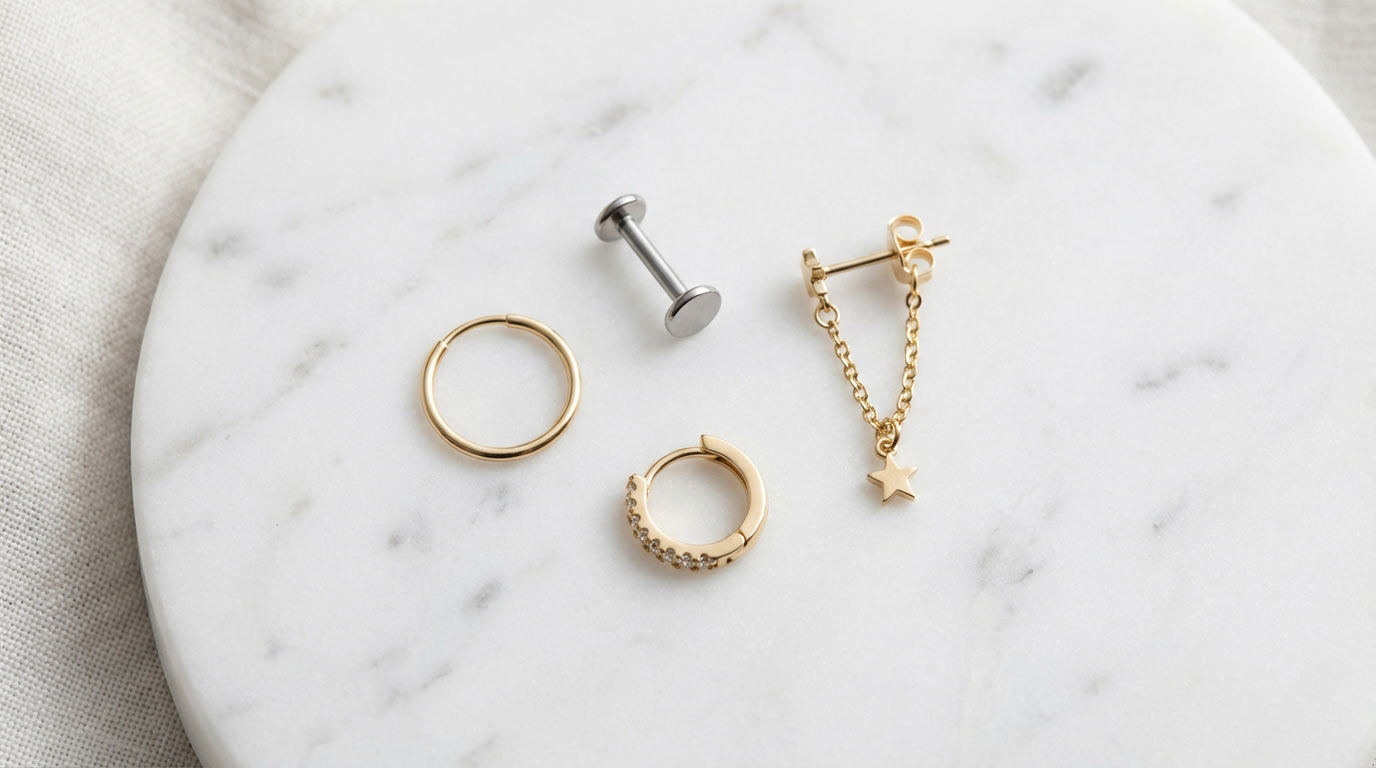
Flat-Back Labret Stud
The #1 choice for new helix piercings. The flat disc back sits flush against the inner cartilage with no protruding end to snag. Threadless or internally threaded. Available with countless decorative tops — gems, opals, bars, hearts. Essential for the long healing period.
Seamless Hoop
The most popular healed helix style. A continuous ring with no visible closure. In titanium or gold. Available in 6mm, 8mm, or 10mm diameters. The classic minimalist helix look. Only safe once fully healed — hoops rotate during healing.
Cartilage Huggie
A small hinged hoop that hugs tightly to the cartilage. Available with gem detailing, plain polished, or textured finishes. The premium everyday healed helix staple. Pairs beautifully in sets of 2–3 up the helix rim.
Chain & Charm Studs
A flat-back stud with a small chain or dangling charm attached. The fashion-forward 2026 helix style. Available in bar shapes, moon charms, stars, and geometric drops. Only appropriate for fully healed piercings as the movement can irritate healing tissue.
Clicker Ring
A hinged hoop with a click-lock closure. Easy to put in and remove. Available in plain titanium or gold with gem settings, geometric shapes, and ornate designs. Popular for the daith but increasingly used in large helix placements too.
Threadless Push-Pin
The decorative top clips onto a bent post — no threads at all. Ultra-smooth insertion, great for healing. The decorative top can be swapped for different styles while keeping the same post. Very popular with premium piercing studios.
Never use hoops in a new helix piercing. A hoop rotates constantly with every head movement, sleep position change, and hair brush. This perpetual movement disrupts the healing fistula channel, introduces bacteria from the outer hoop surface into the wound, and significantly prolongs healing. Hoops belong in your helix only after full healing confirmed by your piercer.
Helix Piercing Jewelry Sizing Guide
Getting the size right matters as much as the material. Helix jewelry that is too short embeds during swelling; too long snags constantly. Here is the full sizing breakdown:
Gauge (thickness)
16g (1.2mm) is standard for most helix piercings. Some piercers use 18g (1.0mm) for more delicate placements or finer jewelry. In the gauge system, lower number = thicker. If your piercer used 16g, only buy 16g helix jewelry — 18g or 20g posts will be too thin and your helix may start to close.
Post Length
Initial: 6–8mm to allow for swelling. After downsizing: 4–6mm fitted precisely to your anatomy. The correct length means the back disc is flush against the skin with minimal gap. For hoops: 6–8mm diameter is standard for most helix placements.
Top / End Size
For initial healing: 2–3mm tops are ideal — small enough not to create pressure but large enough to see. Larger decorative tops (4–5mm+) are fine for healed piercings. Oversized tops pull and rotate during healing, contributing to bumps.
Best approach: Let your professional piercer select and insert initial jewelry — they measure your specific anatomy. When shopping for healed jewelry, bring the card your piercer gave you with your gauge and post length, or visit the studio and ask them to measure.
Helix Piercing Aftercare
Helix aftercare follows the standard cartilage routine but has two specific challenges: hair and pillows. Both are constant irritants unique to this placement that must be actively managed throughout healing.
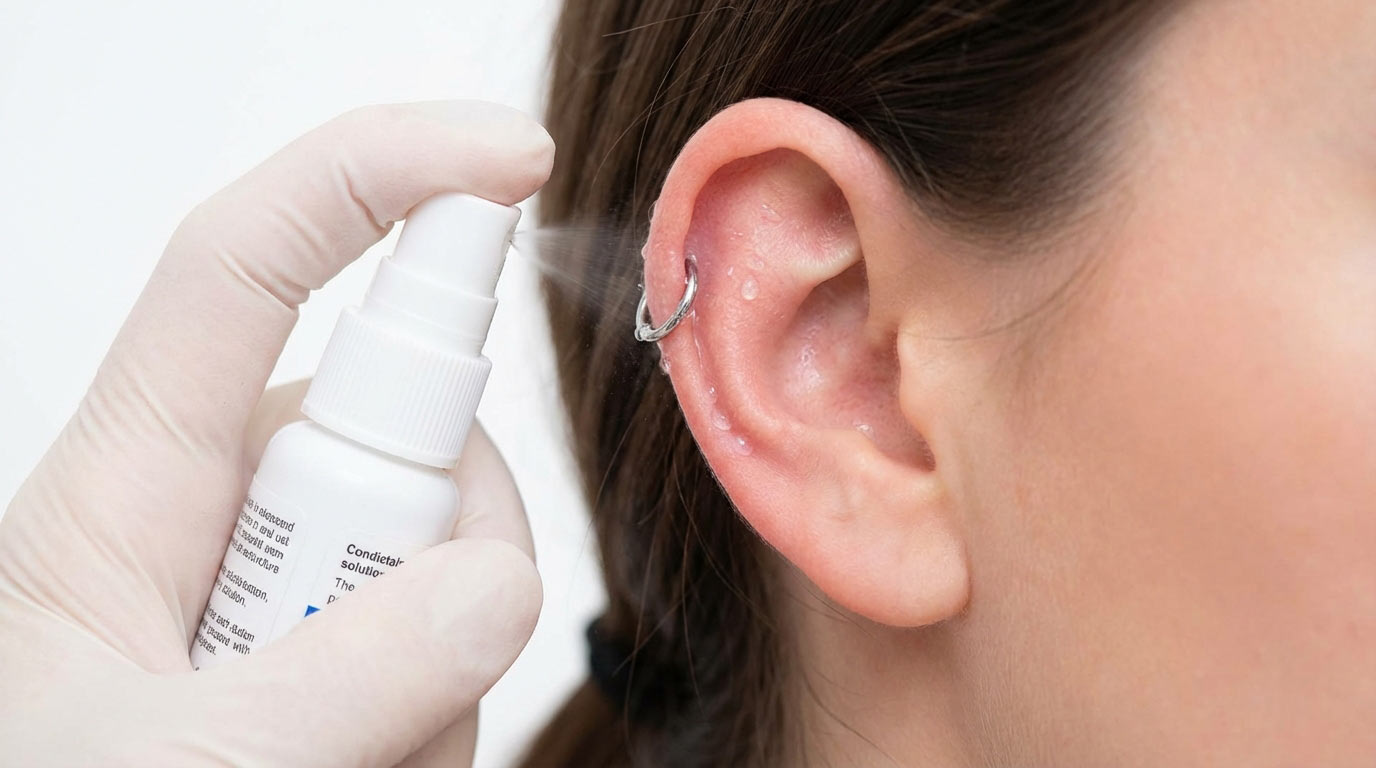
1 — Wash Hands
Every single time before touching your helix. Your hair brushes past it dozens of times a day — your hands add bacteria on top of that.
2 — Sterile Saline Twice Daily
Spray 0.9% NaCl sterile wound wash on front and back of the helix piercing. Let sit 30–60 seconds. Do not rotate. See our Saline Solution Guide for brand recommendations.
3 — Pat Dry
Disposable gauze or paper towel only — never cloth which snags on jewelry. Then leave completely alone until next cleaning.
HELIX DO
- Return at 4–6 weeks for downsizing — non-negotiable
- Use a travel pillow to keep pressure off the helix while sleeping
- Keep hair products, dry shampoo, and hairspray away from the area
- Tie hair back when cleaning to avoid getting hair caught
- Change pillowcases twice per week throughout healing
- Remove over-ear headphones from the helix side during healing
HELIX DON'T
- Never rotate or twist helix jewelry — causes micro-tears
- Don't sleep on the pierced side — use a travel pillow
- Don't let hair tangle around the jewelry during healing
- Don't use alcohol, hydrogen peroxide, or tea tree oil
- Don't change to a hoop before full healing is confirmed
- Don't over-clean — twice daily only
Full aftercare guide: Complete Piercing Aftercare Guide · Saline Solution Guide
Helix Piercing Bump — The Most Common Problem & How to Fix It
The helix bump is the most-searched helix piercing problem — and it is almost always an irritation bump or hypertrophic scar, not a keloid. Here is the reality:
Cause #1: Post Too Long
The initial 6–8mm post sways, snags on hair and pillowcases, and creates constant micro-trauma. Fix: Downsize at week 4–6. This alone resolves the majority of helix bumps.
Cause #2: Sleeping on It
8 hours of nightly pressure on a healing helix is a primary bump cause. Fix: Travel pillow with ear hole. Non-negotiable for helix healing.
Cause #3: Hair Snagging
Hair catches on the exposed flat-back post constantly during the long healing period. Fix: Tie hair back during cleaning. Keep hair products away. A shorter downsized post snags less.
Cause #4: Reactive Jewelry
Non-titanium or plated jewelry causes allergic reactions that mimic infection. Fix: Switch to ASTM F136 implant-grade titanium if not already. Resolves many persistent bumps.
Bump treatment summary: (1) Downsize the post. (2) Switch to titanium. (3) Use travel pillow. (4) Clean saline twice daily. (5) Remove all irritants. Most helix bumps resolve completely within 4–8 weeks of fixing the cause. See our full Piercing Bump vs Keloid Guide for more.
How Much Does a Helix Piercing Cost?
Helix piercing costs vary by studio quality and jewelry material. Here is a realistic 2026 breakdown:
| Venue Type | Price Range | Includes | Notes |
|---|---|---|---|
| Mall Kiosk / Chain | $15–$35 | Starter earring | Gun piercing — never for cartilage |
| Professional Studio — Titanium | $35–$70 | Needle + implant titanium flatback | Recommended option |
| Professional Studio — Gold | $70–$120 | Needle + solid 14k gold flatback | Premium starter jewelry |
| High-End Studio (Studs, Rowan) | $80–$150 | Premium placement + jewelry consultation | Best experience, curated ear planning |
| Double Helix (same session) | $60–$120 | Two piercings + two flatback studs | Most studios offer slight discount for both |
| Downsizing Appointment | $15–$30 | Shorter post, same material | Critical — do not skip this |
UK pricing: Professional studio helix £30–£60. Double helix £50–£100. Downsizing £12–£25. EU: Similar range in local currency. Never choose the cheapest option for cartilage — the extra cost of a professional studio is minimal compared to the risk of complications.
Helix Styling & Trend Inspiration 2026
The helix is the cornerstone of the curated ear trend — the most photographed and styled placement in 2026. Here is what is trending:
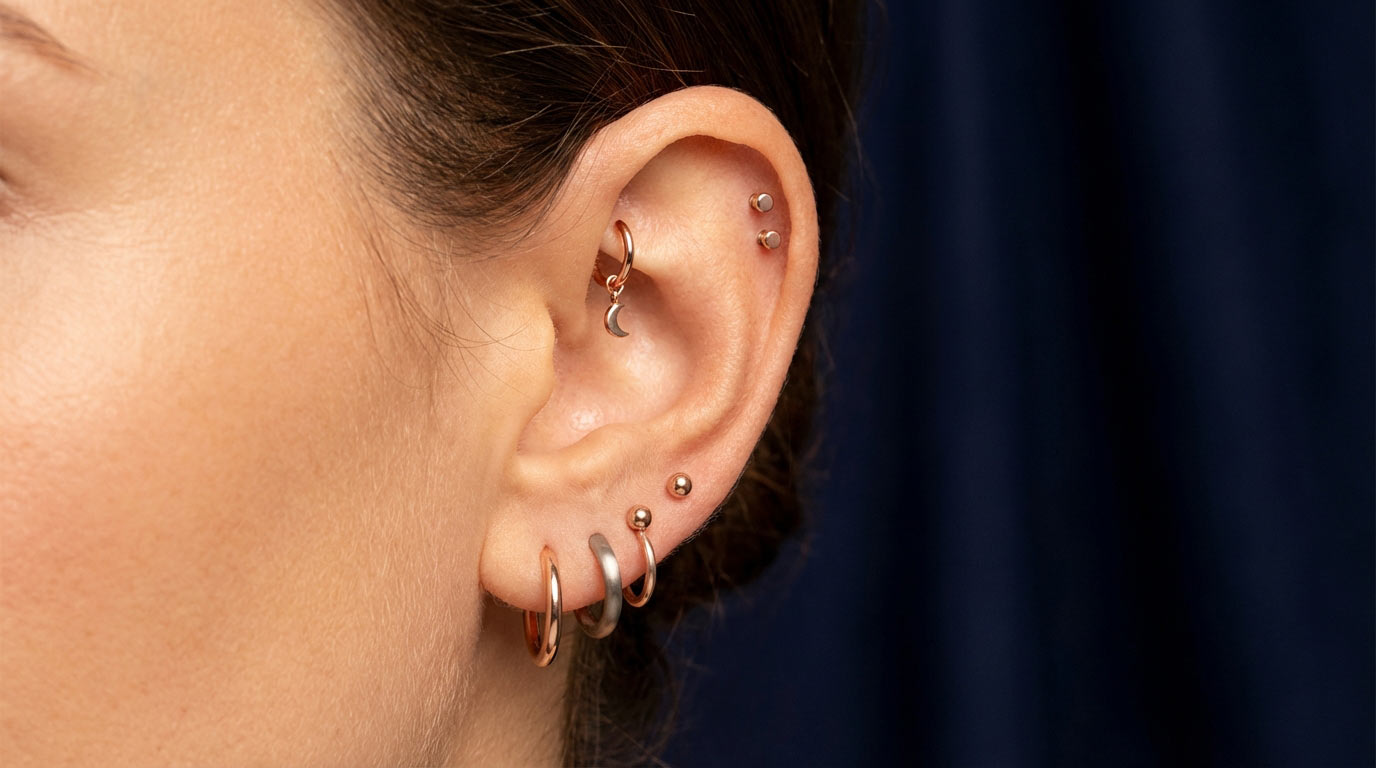
Hidden Helix
Inner helix fold placement. Barely visible from the front — glints subtly from an angle. The “quiet luxury” look dominating 2026.
Double Stack
Two matched studs stacked on the helix rim. Versatile — use identical gems for symmetry or mix metals for contrast.
Snakebite Helix
Two piercings placed very close together to mimic snake fangs. Trending on mid-helix and flat helix placements.
Helix to Lobe Chain
A delicate chain connecting a healed helix stud to a lobe earring. One of the most-pinned ear looks of 2026. Healed piercings only.
Graduating Hoops
Multiple hoops of decreasing size going up the helix rim. Classic but modern. Only suitable for fully healed piercings.
Asymmetric Stacks
Heavy helix stack on one ear, minimal or single stud on the other. The defining aesthetic of curated ear culture in 2026.
Planning a helix stack: Get no more than 2–3 piercings at once. Each helix requires 6–12 months of aftercare. Build your stack slowly — spacing piercings 3–6 months apart lets each heal before you add the next. The final result is absolutely worth the patience.
Frequently Asked Questions
How much does a helix piercing hurt?
A helix piercing rates 4/10 for pain — the least painful cartilage piercing. The outer cartilage rim has fewer nerve endings than deeper placements like the tragus or rook. The piercing moment lasts under one second with a skilled needle piercer. Most people describe it as a sharp pressure followed by mild throbbing for a few hours. Significantly less painful than a rook, conch, or industrial.
How long does a helix piercing take to heal?
A helix piercing takes 6–12 months for full internal healing. The surface may appear healed at 3–4 months but internal tissue continues healing significantly longer. Do not change jewelry based on how it looks — have your professional piercer confirm healing. Return at 4–6 weeks for a critical downsizing appointment to prevent bumps from the long initial post.
What is the best jewelry for a helix piercing?
A flat-back labret stud in implant-grade titanium (ASTM F136) is the best initial helix jewelry. Standard gauge is 16g with a 6–8mm post. Threadless or internally threaded. Once fully healed (6–12 months), you can switch to seamless hoops, cartilage huggies, clicker rings, or chain studs. Never use hoops in a new helix — they rotate and delay healing.
What gauge is a helix piercing?
Most helix piercings are performed at 16 gauge (1.2mm). Some piercers use 18g (1.0mm) for more delicate placements. Always match new jewelry to the gauge your piercer used — buying 18g or 20g for a 16g helix means the posts will be too thin and the piercing may start to close. When in doubt, visit your piercer and ask them to confirm your gauge before shopping.
Can I sleep on my helix piercing?
No — sleeping directly on a healing helix is the #1 cause of helix bumps. The consistent pressure and movement against a pillow disrupts the healing fistula. Use a travel pillow with an ear hole to keep pressure off while sleeping. This single change resolves the majority of helix bumps. Always sleep on the opposite side during the full 6–12 month healing period.
What is the difference between a helix and forward helix?
A standard helix is placed along the upper outer rim of the ear cartilage. A forward helix is placed on the front-facing rim where the ear meets the head — making it highly visible from the front. Both are helix piercings but at different positions on the cartilage rim. Forward helix is slightly more anatomy-dependent and rates 4–5/10 pain vs 4/10 for standard helix.
How much does a helix piercing cost?
A helix piercing at a professional studio costs $35–$70 including implant-grade titanium starter jewelry. High-end studios with solid 14k gold charge $70–$150. Double helix in one session runs $60–$120. Always budget for a downsizing appointment at week 4–6 ($15–$30) which is critical for helix healing. Mall kiosks charge less but use piercing guns — never appropriate for cartilage.
Is a helix piercing good for beginners?
Yes — the standard helix is the #1 recommended first cartilage piercing. It is the least painful cartilage placement, heals well for a first-time cartilage experience, is easy to clean due to its accessible outer-rim position, and offers maximum jewelry versatility once healed. It gives you the full cartilage aftercare experience without the added difficulty of deeper placements like the rook, daith, or snug.
Questions about your helix piercing?
Drop them in the comments — we answer every one!