
Complete Guide · Cartilage Piercing · 2026
Cartilage Piercing:
The Complete Guide
Every cartilage piercing type explained — why cartilage heals differently to lobes, pain levels, healing times, safe jewelry, aftercare, and the curated ear trend shaping 2026.
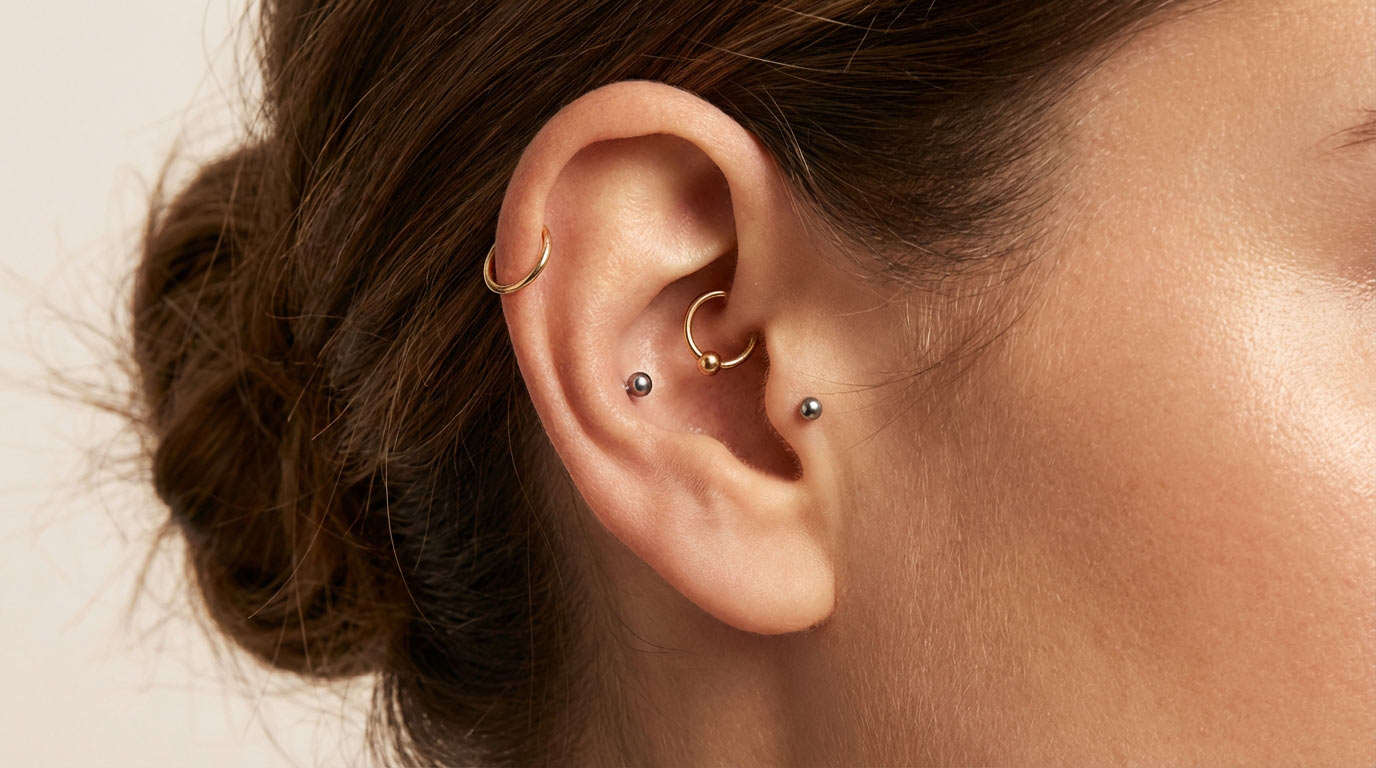
Helix is the most popular cartilage piercing worldwide
Distinct cartilage piercing placements on the ear
Months for full cartilage healing — vs 3–6 for lobes
Use a piercing gun on cartilage — risk of shattered tissue
ASTM grade titanium — the only safe initial jewelry material
Distinct cartilage piercing types on one ear
Pain range across all cartilage types (out of 10)
Months for full internal cartilage healing
Standard gauge for most cartilage piercings
Rule: Never use a piercing gun on cartilage
Cartilage piercings are not just a step up from the earlobe — they are a fundamentally different experience. Different anatomy, different healing biology, different aftercare requirements, and significantly higher stakes if something goes wrong. Understanding these differences before you pierce is the single most important thing you can do for a successful outcome.
What Is a Cartilage Piercing?
A cartilage piercing is any piercing that passes through the firm, fibrous connective tissue of the ear rather than the soft fleshy earlobe. Cartilage is the rigid but flexible material that gives the outer ear its shape — it is the same type of tissue found in the nose, throat, and joints.
Unlike the earlobe, which is composed of soft adipose (fatty) tissue richly supplied with blood vessels, ear cartilage has very limited blood supply. This single biological fact is responsible for virtually every difference between cartilage and lobe piercings — the longer healing times, the higher infection risk, the greater chance of irritation bumps, and the reason why cartilage infections are medically more serious.
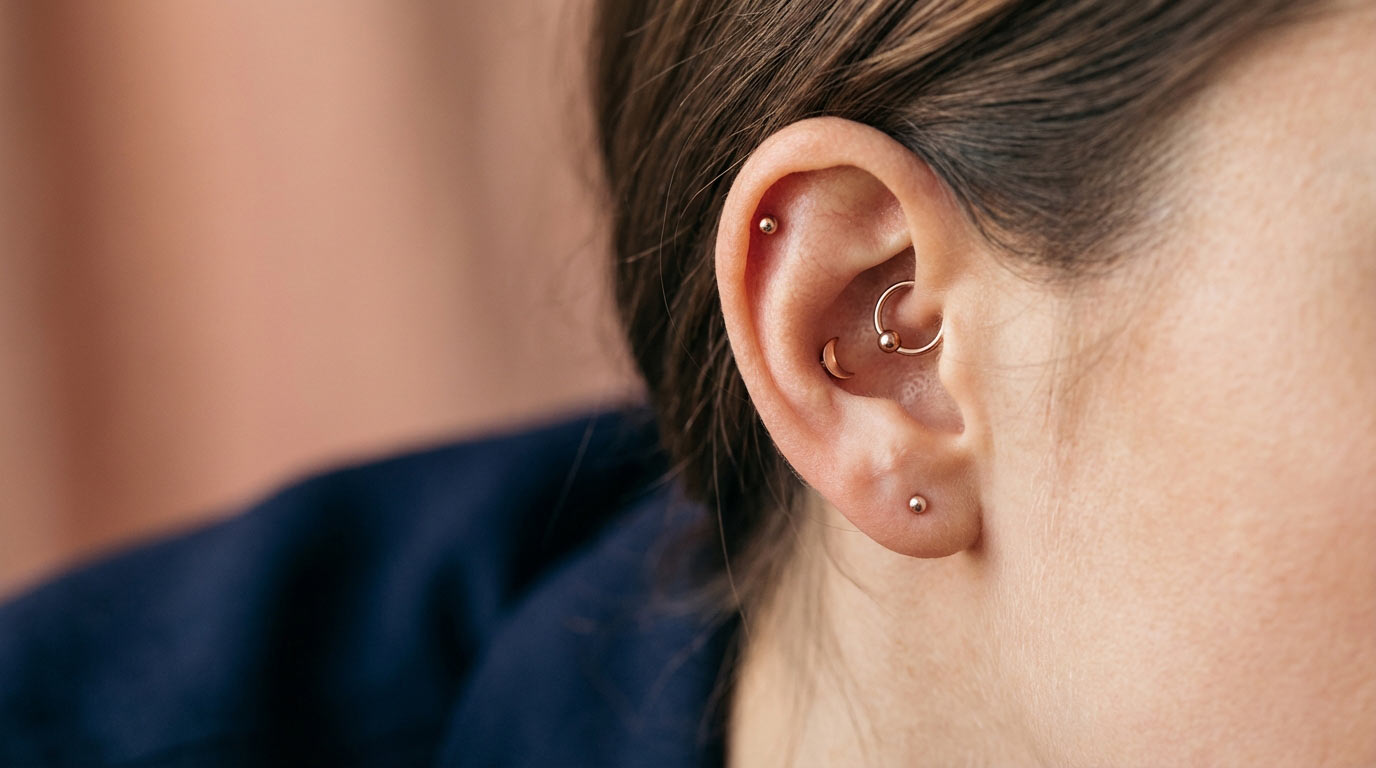
Cartilage piercings include everything above and around the earlobe: helix, flat helix, forward helix, daith, tragus, antitragus, conch, rook, snug, and industrial. Each placement sits in a different part of the cartilage anatomy with its own healing characteristics.
Why cartilage heals slowly: Blood delivers oxygen, white blood cells, and nutrients that the body uses to heal wounds. With cartilage receiving far less blood than soft tissue, the healing process takes 2–4 times longer. This is not a sign that anything is wrong — it is simply the biology of cartilage tissue.
Cartilage vs Earlobe Piercing — Key Differences
Understanding how cartilage differs from the lobe is essential before making a decision. These are not minor differences — they affect everything from how long you will be in aftercare to how seriously you need to take any complication:
Earlobe Piercing
- Soft, fatty tissue with rich blood supply
- Heals in 3–6 months
- Pain: 2/10 — very mild
- Minor infections usually manageable at home
- Lower risk of irritation bumps
- More jewelry flexibility during healing
- Suitable for piercing guns (though needle still preferred)
- Good choice for first piercing
Cartilage Piercing
- Firm tissue with very limited blood supply
- Heals in 6–12 months
- Pain: 4–7/10 depending on placement
- Infections reach cartilage poorly — more serious risk
- Higher risk of hypertrophic scars and bumps
- Strict jewelry rules during long healing period
- Needle ONLY — gun can shatter cartilage
- Research your piercer more carefully
| Feature | Earlobe | Cartilage (avg) |
|---|---|---|
| Tissue type | Soft adipose tissue | Dense fibrocartilage |
| Blood supply | Rich — fast healing | Limited — slow healing |
| Healing time | 3–6 months | 6–12 months |
| Pain level | 2/10 | 4–7/10 |
| Bump risk | Low | Higher — common |
| Infection severity | Usually minor | Potentially serious — perichondritis risk |
| Antibiotic effectiveness | Good — tissue accessible | Reduced — limited blood flow |
| Piercing gun | Acceptable (needle preferred) | NEVER — risk of fracture |
| Initial jewelry | Flatback stud | Flatback stud only — no hoops |
All Cartilage Piercing Types — Complete Reference
There are over ten distinct cartilage piercing placements. Here is every one explained with anatomy, healing, pain level, and ideal jewelry:
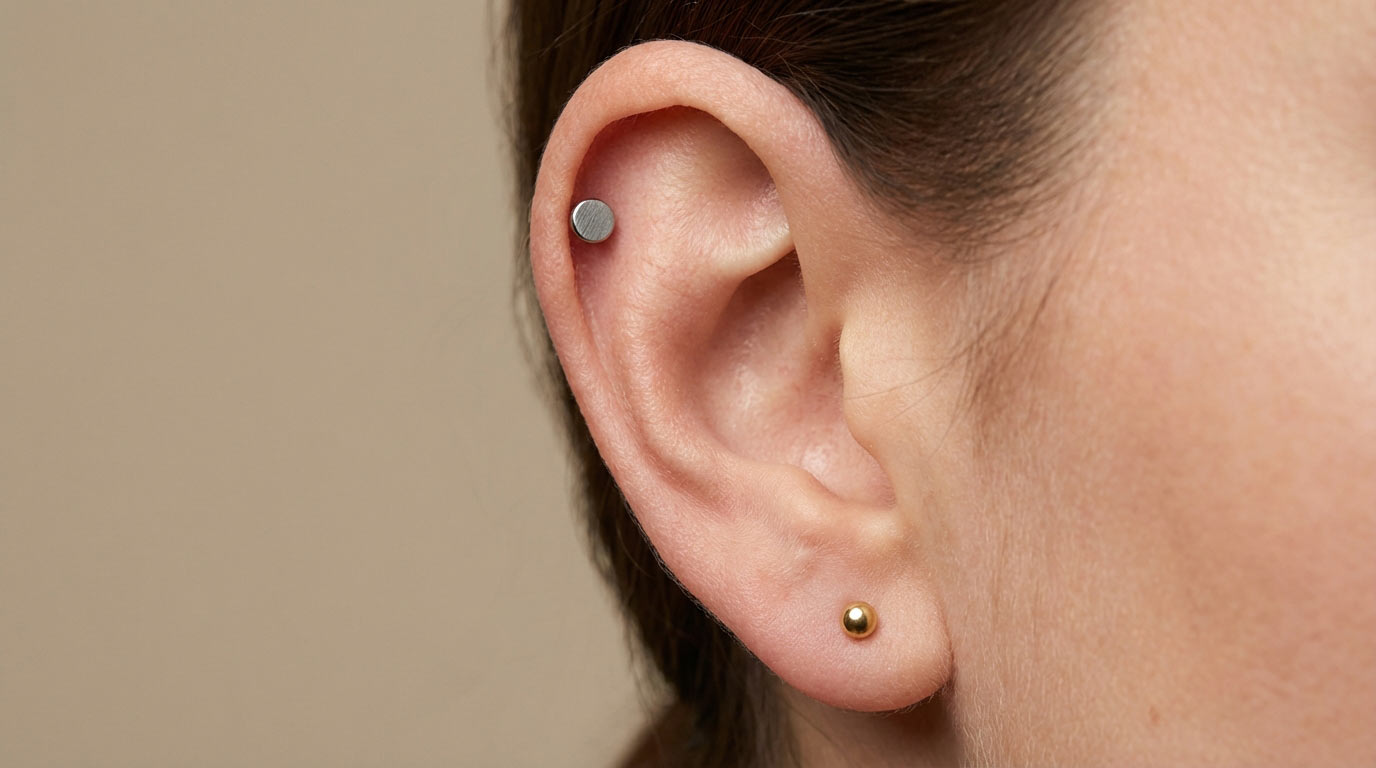
Helix
The outer rim of the upper ear cartilage. The most popular cartilage piercing worldwide — approximately one in four cartilage piercings. Works beautifully with studs, hoops, and chains. The safest first cartilage piercing.
Hidden Helix
Placed in the inner fold of the helix, partially concealed when viewed from the front. One of the fastest-growing placements of 2026 — the "quiet luxury" cartilage piercing. Dainty charms visible only from certain angles.
Double Helix
Two piercings stacked on the helix rim, either vertically or along the curve. The #1 cartilage trend of 2026 according to professional piercers. Maximum impact, highly customizable.
Flat Helix
Placed in the large flat panel of cartilage below the outer helix rim. Provides a wide canvas for decorative statement jewelry. Anatomy-dependent — flat panel size varies person to person.
Forward Helix
On the front-facing cartilage rim where the ear meets the head. Highly visible from the front, great for stacking with other placements. One of the most photogenic ear piercings.
Tragus
Through the small oval flap of cartilage that partially covers the ear canal. Dainty, unique, and very popular. Rumored acupressure point for migraines. Avoid in-ear headphones during healing.
Daith
Through the innermost fold of cartilage above the ear canal. Gained huge popularity through rumored migraine relief claims — science is inconclusive but it looks stunning. Best with clickers and hoops.
Conch
In the large curved bowl of inner cartilage. Inner conch uses a stud; outer conch suits a hoop. The bold canvas of ear piercings — larger jewelry creates significant visual impact.
Rook
Through the anti-helix ridge above the daith — the inner fold above the ear canal. Anatomy-dependent and more painful than most. Visually distinctive because of the unusual jewelry angle.
Snug
A horizontal piercing through the anti-helix ridge between the inner conch and the rim. Anatomy-dependent — many people lack sufficient cartilage for this placement. Higher rejection risk than most.
Industrial
Two piercings connected by a single long straight barbell — typically forward helix to helix. Bold, architectural, and dramatic. Both holes must heal simultaneously which makes aftercare more complex.
Antitragus
Through the small ridge of cartilage directly opposite the tragus, above the earlobe. Less common but visually interesting. Anatomy-dependent — requires sufficient cartilage prominence in this area.
Anatomy matters for cartilage: Unlike lobe piercings which work on virtually everyone, several cartilage placements — particularly the rook, snug, daith, and industrial — are anatomy-dependent. Your piercer will assess whether your ear structure can support the placement before agreeing to pierce. Never push for a placement your anatomy cannot support.
Cartilage Piercing Pain Levels — All Types Ranked
Cartilage piercings are universally more painful than lobe piercings because the needle must penetrate dense fibrous tissue rather than soft flesh. The actual piercing moment still lasts under a second — what varies is the pressure sensation and throbbing that follows.
Reference point: Earlobe = 2/10. All cartilage piercings start above that.
Start with the helix if you are new to cartilage piercings. It is the least painful cartilage placement, heals well, and gives you the full cartilage aftercare experience before attempting more complex or painful locations. Most people underestimate how manageable a helix piercing is.
Cartilage Piercing Healing Times
The most important thing to understand about cartilage healing: surface healing and full internal healing are completely different milestones. Your piercing may look and feel fine on the surface 3–4 months in while the internal tissue is still fragile and actively healing.
Changing jewelry before full healing — even when it seems fine — is the leading cause of cartilage piercing complications.
| Piercing | Surface Healing | Full Internal Healing | Earliest Jewelry Change |
|---|---|---|---|
| Earlobe (reference) | 6–8 weeks | 3–6 months | After 2–3 months (piercer) |
| Helix / Flat Helix | 3–6 months | 6–12 months | After 4–6 months (piercer confirms) |
| Forward Helix | 3–6 months | 6–12 months | After 4–6 months (piercer confirms) |
| Tragus | 4–6 months | 6–12 months | After 6 months (piercer confirms) |
| Daith | 4–6 months | 6–12 months | After 6 months (piercer confirms) |
| Conch | 4–6 months | 6–12 months | After 6 months (piercer confirms) |
| Industrial | 4–6 months | 6–12 months | After 6+ months (piercer confirms) |
| Rook | 4–6 months | 6–12 months | After 6+ months (piercer confirms) |
| Snug | 4–6 months | 6–12 months | After 6+ months (piercer confirms) |
The downsizing step: At 4–6 weeks, return to your piercer to swap the initial longer post for a shorter one fitted to your anatomy. This single step is the most overlooked part of cartilage healing — the long initial post snags on hair, pillowcases, and clothing constantly, causing the irritation bumps that plague so many cartilage piercings. Downsizing resolves the majority of cartilage bumps within weeks.
Needle vs Piercing Gun — Why It Matters Even More for Cartilage
For earlobe piercings, the difference between needle and gun is significant. For cartilage piercings, using a gun is potentially dangerous:
Guns Can Shatter Cartilage
Piercing guns use spring-loaded force to drive a blunt stud through tissue. In soft earlobe tissue, this causes trauma. In rigid cartilage, this blunt force can literally fracture or shatter the cartilage structure — causing permanent damage, significant scarring, and risk of serious infection.
APP Prohibition
The Association of Professional Piercers explicitly prohibits the use of piercing guns on cartilage. Any studio offering cartilage gun piercings is not following professional safety standards and should be avoided.
Hollow Needle — The Only Option
A hollow needle removes a small core of tissue, creating a clean channel with minimal trauma. This is the only safe method for cartilage piercing. Single-use, disposable, sterilized. Always ask to see the needle opened from its sterile packaging before your piercing.
Best Jewelry for Cartilage Piercings
Cartilage jewelry rules are stricter than lobe jewelry rules because movement and material quality directly affect the much longer healing period:
| Jewelry Style | For New Cartilage? | Best For | Notes |
|---|---|---|---|
| Flat-Back Labret Stud | ✅ Best Choice | Helix, flat, forward helix, tragus, conch | Sits flush — no snagging. Internally threaded or threadless only |
| Curved Barbell | ✅ Standard | Rook, daith, snug | Follows anatomy of curved placements |
| Straight Barbell | ✅ Industrial only | Industrial | Must be sized longer for initial swelling |
| Clicker / Hinged Ring | ⚠️ Healed Only | Daith, rook (healed) | Excellent for healed piercings. Too much movement for healing |
| Seamless Hoop | ⚠️ Healed Only | Helix, conch (healed) | Rotates during healing — causes irritation and prolongs healing |
| Circular Barbell | ⚠️ Some placements | Daith (starter), some conch | Only where specifically recommended by piercer |
Safe Materials for Cartilage
Implant-Grade Titanium (ASTM F136)
Best choice. Nickel-free, lightest metal, hypoallergenic. Essential for sensitive skin or long cartilage healing periods.
14k or 18k Solid Gold (nickel-free)
Premium choice. Biocompatible and beautiful. Verify it is explicitly nickel-free. White, yellow, and rose gold all acceptable.
Avoid: Silver, Plated, Unknown Metals
Sterling silver oxidizes in body fluids. Plated jewelry exposes nickel base. Unknown metals cause allergic reactions during the long cartilage healing period.
See full materials guide: Best Jewelry for New Piercings
Cartilage Piercing Aftercare
Cartilage aftercare follows the same basic routine as other piercings but must be maintained for the full 6–12 month healing period — not just until the surface looks healed:
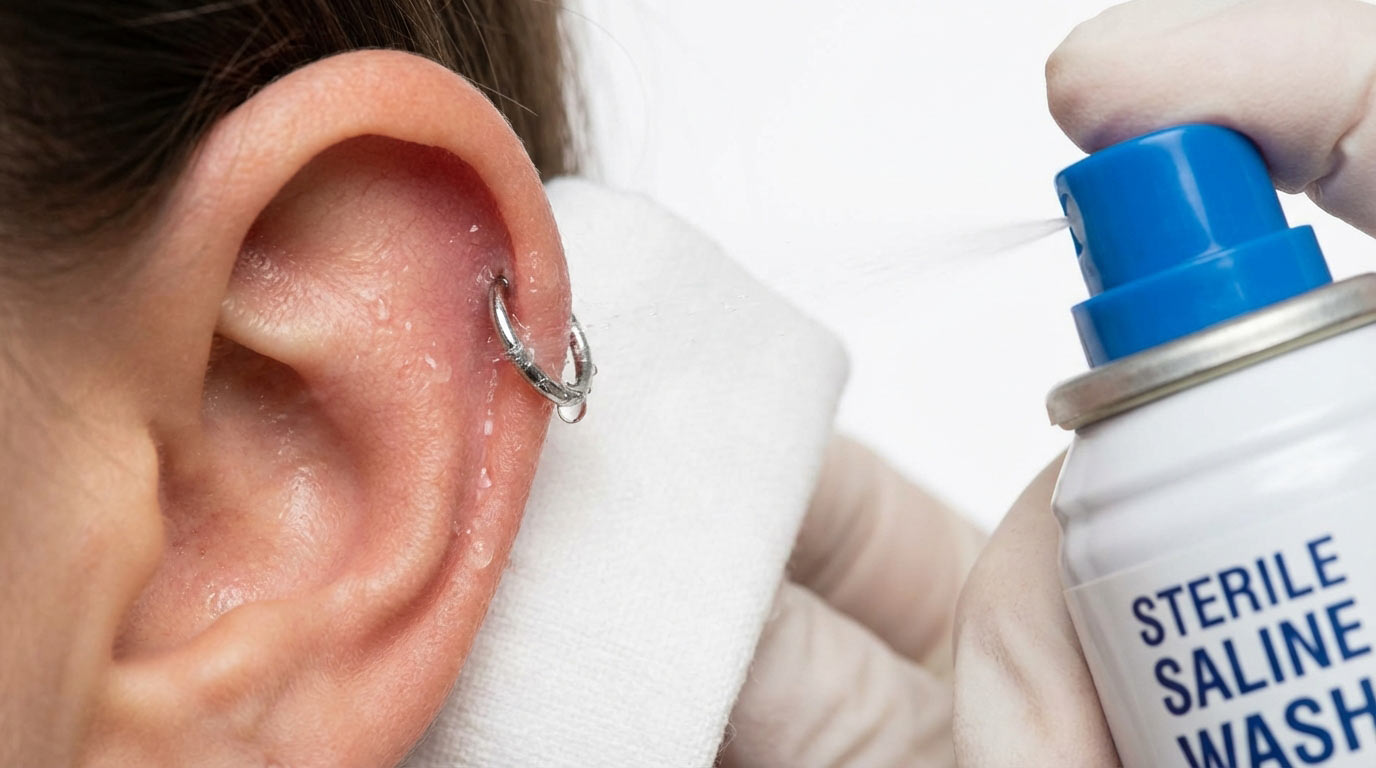
1 — Wash Hands
Always before touching your piercing. Cartilage piercings are particularly vulnerable during their long healing window — every unnecessary touch is a risk.
2 — Sterile Saline Twice Daily
Spray sterile saline wound wash (0.9% NaCl only) on front and back of the piercing twice per day. Let sit 30–60 seconds. Do not rotate the jewelry — ever. See our Saline Solution Guide.
3 — Pat Dry & Leave It
Gently pat dry with disposable gauze or paper towel. Never cloth towels. Then completely leave it alone. Twice daily, every day, for the full healing period.
CARTILAGE DO
- Return at 4–6 weeks for downsizing — critical for cartilage
- Use a travel pillow to avoid sleeping on cartilage piercings
- Change pillowcases twice weekly throughout the healing period
- Keep hair products, dry shampoo, and perfume away from the area
- Remove in-ear headphones from tragus / helix piercings
- See a doctor same day for any sign of spreading redness
CARTILAGE DON'T
- Never rotate or twist cartilage jewelry — causes micro-tears
- Don't sleep directly on cartilage piercings
- Don't swim in pools, hot tubs, or lakes during healing
- Don't use alcohol, hydrogen peroxide, or tea tree oil
- Don't attempt home treatment for cartilage infections
- Don't change jewelry without piercer confirmation
Cartilage Piercing Bumps — Causes & Treatment
Cartilage piercings develop bumps more frequently than lobe piercings. This is extremely common — and in the vast majority of cases, it is an irritation bump or hypertrophic scar, not a keloid. Here is how to handle it:
Cause #1: Long Initial Post
The most common cause. The initial longer post sways and snags constantly during the long cartilage healing period. Fix: Downsize at 4–6 weeks. Most cartilage bumps resolve within weeks of downsizing.
Cause #2: Sleeping on the Piercing
Eight hours of pressure and movement every night on a healing cartilage piercing causes significant irritation. Fix: Travel pillow with hole for the ear. Essential for helix, flat, and conch piercings.
Cause #3: Reactive Jewelry Material
Nickel, plated metals, or mystery alloys cause allergic reactions that manifest as bumps. Fix: Switch to implant-grade titanium if not already using it. This resolves a large proportion of cartilage bumps.
When It Might Be a Keloid
If the bump appeared months after piercing, extends beyond the piercing hole, feels firm and rubbery, and keeps growing — see a dermatologist. True keloids require medical treatment. See our Bump vs Keloid Guide.
Cartilage Infection Warning — Why It Is Medically Serious
Cartilage infections are not the same as earlobe infections. Because cartilage has limited blood supply, antibiotics reach it poorly. Infections can spread rapidly through cartilage and cause perichondritis — an infection of the cartilage membrane that can permanently deform the ear if not treated promptly. Any spreading redness, fever, or worsening symptoms in a cartilage piercing requires same-day medical attention.
| Issue | What It Looks Like | Action |
|---|---|---|
| Normal Healing | Mild redness, clear/white crusties, mild tenderness improving over time | Continue aftercare — expected |
| Irritation Bump | Small soft bump at piercing site — stable, not spreading | Downsize, switch to titanium, remove irritants |
| Minor Infection | Slightly increased redness, warmth, mild thickening of discharge | Improve aftercare. See doctor if not improving in 3–5 days |
| Moderate Infection | Clear pus, increasing pain and swelling not improving | See a doctor — likely needs antibiotics |
| Serious Infection | Spreading redness, fever, chills, red streaks, feeling unwell | Medical emergency — urgent care or ER immediately |
| Perichondritis | Ear shape changing, cartilage softening, severe pain and swelling | Emergency — IV antibiotics or surgery may be required |
For full infection signs and treatment guide see: Infected vs Irritated Piercing Guide
Curated Ear & Cartilage Trends 2026
The cartilage piercing category is being driven by the curated ear (earscape) trend — the design of multiple piercings across the ear as a composed, styled look. Cartilage piercings are the primary building blocks of a curated ear.
These are the cartilage-specific trends dominating 2026:
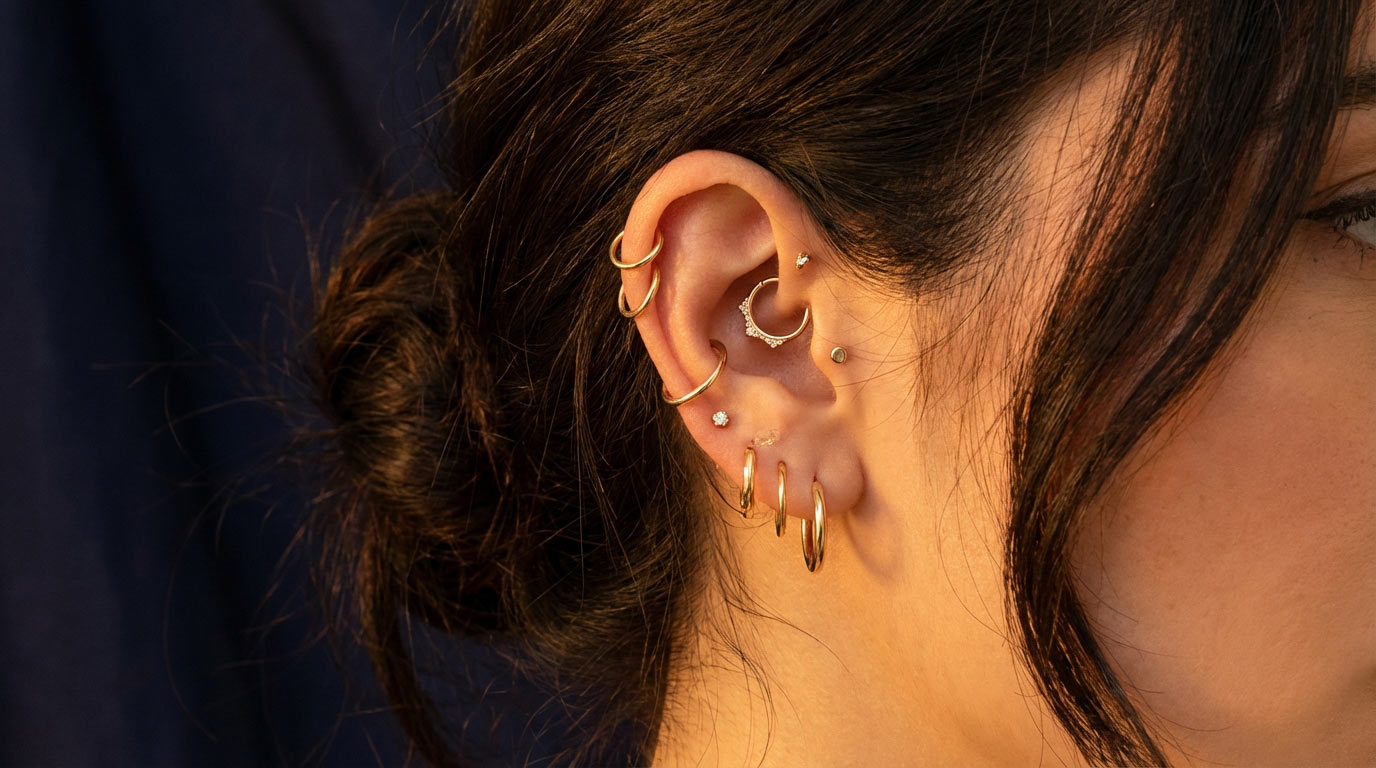
Hidden Helix
Placed in the inner helix fold — subtly visible, giving a "quiet luxury" effect. The fastest-growing cartilage trend of 2026.
Double Helix
Two helix piercings stacked vertically or along the rim. The #1 recommended 2026 upgrade from a single helix.
Snakebite Ear
Two close piercings resembling snake fangs — mid-helix, flat helix, or conch. Trending from late 2024 into 2026.
Chain Connections
Small chains connecting two healed cartilage piercings (e.g. helix to lobe). Fashion-forward styling for healed piercings only.
Constellation Cartilage
Multiple small titanium or gold studs placed in a pattern across the cartilage — mimicking a star constellation. Requires multiple healed piercings.
Asymmetric Stacking
Heavy cartilage stack on one ear, minimal or single lobe on the other. The most-photographed ear aesthetic on social media in 2026.
Curated ear planning tip: Do not get more than 2–3 new piercings at once. Each cartilage piercing requires 6–12 months of careful aftercare. Spacing piercings 3–6 months apart allows each to establish before you add another. Build your ear gallery slowly — the final result is worth the patience.
Frequently Asked Questions
How long does a cartilage piercing take to heal?
Most cartilage piercings take 6–12 months for full internal healing. The surface may appear healed at 3–4 months but internal tissue is still fragile. Helix, tragus, daith, conch, and rook all fall in this range. The industrial can take the full 12 months. Never change cartilage jewelry based on how it looks — always have your professional piercer confirm full healing first.
Does a cartilage piercing hurt more than a lobe piercing?
Yes — cartilage piercings are generally more painful than lobe piercings. Lobes rate 2/10; cartilage piercings range from 4/10 (helix) to 6.5/10 (snug, industrial). The actual piercing moment still lasts under a second with a skilled needle piercer — most people find cartilage piercings more manageable than they expected. The helix is the recommended first cartilage piercing for its relatively low pain rating.
What is the easiest cartilage piercing to heal?
The helix piercing is considered the easiest cartilage piercing to heal — it is on the accessible outer rim, easy to clean, and receives less pressure than inner-ear placements. The flat helix and forward helix are also good beginner cartilage choices. The most difficult to heal are the rook, snug, and industrial due to their depth and higher risk of irritation from movement.
Why do cartilage piercings take longer to heal than earlobes?
Cartilage tissue has very limited blood supply compared to the earlobe. Blood carries the oxygen, immune cells, and nutrients the body uses to heal wounds. With significantly less blood reaching cartilage tissue, the healing process is 2–4 times slower than soft tissue. This is biology, not a sign that anything is wrong — it simply means cartilage piercings require longer, more consistent aftercare.
Can I use a piercing gun on cartilage?
Never. Piercing guns use blunt force that can shatter or fracture cartilage tissue, causing permanent damage. The APP explicitly prohibits gun piercing of cartilage. Any professional studio that offers cartilage gun piercing does not follow safety standards. Always choose a studio using single-use hollow needles only.
What is the best jewelry for a new cartilage piercing?
A flat-back labret stud in implant-grade titanium (ASTM F136) is the best starter jewelry for most cartilage piercings. It sits flush against the skin with no protruding parts that snag during the long healing period. Never use hoops or rings in new cartilage piercings — they rotate with every movement and significantly delay healing. Hoops are only appropriate once full healing is confirmed by your piercer.
Are cartilage piercing infections serious?
Yes — cartilage infections are significantly more serious than earlobe infections. The limited blood supply means antibiotics reach cartilage poorly, allowing infections to spread. A serious cartilage infection can cause perichondritis — infection of the cartilage membrane that can permanently deform the ear. Any spreading redness, fever, or worsening symptoms in a cartilage piercing requires same-day medical attention, not home treatment.
What is the most popular cartilage piercing in 2026?
The helix remains the most popular cartilage piercing overall, accounting for approximately one in four cartilage piercings. In 2026, the hidden helix and double helix are the fastest-growing placements. Other highly in-demand options include daith, tragus, conch, and snakebite ear. The curated ear trend — multiple coordinated cartilage piercings designed as a single composed look — is the defining aesthetic of 2026.
Questions about your cartilage piercing?
Drop them in the comments — we answer every one!