
Complete Guide · Piercing Jewelry
Best Jewelry for Sensitive Skin:
Hypoallergenic Earrings & Implant Grade Titanium Guide
The complete guide to safe piercing materials — implant-grade titanium, nickel-free gold, what causes earring allergies, and which metals to avoid.
The single most important decision in any piercing is not the placement, the piercer, or the aftercare routine — it is the jewelry material. The wrong metal causes reactions, delays healing, and can turn a straightforward piercing into a months-long complication.
Materials Ranked — Best to Worst for Sensitive Skin
Not all metals are equal. Here is the definitive ranking with reasons:
Implant-Grade Titanium (ASTM F136)
The gold standard for sensitive skin and all new piercings. ASTM F136 is the same grade used in surgical implants inside the human body. Contains zero nickel, zero lead, zero cadmium. Lightweight — roughly half the weight of steel. Can be anodized in any colour without chemical coating. Hypoallergenic for virtually everyone including those with severe nickel allergies.
Look for: ASTM F136 or ISO 5832-3 certification on the product listing.
Solid 14k or 18k Gold (Nickel-Free)
Premium choice for healed piercings and for those who prefer gold aesthetics. Biocompatible and beautiful. Must be explicitly stated as nickel-free — some gold alloys use nickel as a hardening agent. Yellow, white, and rose gold are all acceptable. Available in solid (safest), vermeil (gold over silver), and filled (not recommended for piercings).
Look for: Solid 14k or 18k gold with explicit nickel-free statement.
Implant-Grade Steel (ASTM F138 / F1537)
Widely used and generally safe for most people. Contains trace nickel (approximately 0.05%) — within safe limits for most but may cause reactions in those with severe nickel sensitivity. Heavier than titanium. Does not allow colour anodizing. A solid choice if you are not highly nickel-sensitive.
Look for: ASTM F138 or F1537 — not just "surgical steel" which is an unregulated marketing term.
Plated Jewelry, Sterling Silver & Unknown Alloys
Gold-plated, silver-plated, and rose gold-plated jewelry uses a thin coating over a reactive base metal. The plating wears off with body fluid exposure — often within weeks — exposing the nickel or brass underneath. Sterling silver (92.5% silver) contains up to 7.5% other metals, frequently including nickel. Unknown alloys, "hypoallergenic" without certification, and fashion jewelry should never be used in piercings.
Signs you have the wrong material: Itching, redness, crusty discharge that won't resolve, greenish skin staining.
What “Implant Grade” Actually Means
The term "implant grade" is one of the most misused terms in piercing jewelry marketing. Here is what it actually means — and how to verify it:
What It Means
Implant-grade means the metal meets ASTM (American Society for Testing and Materials) or ISO standards for use inside the human body. For titanium: ASTM F136. For steel: ASTM F138 or F1537. These standards certify exact elemental composition, surface finish, and biocompatibility.
How to Verify It
Legitimate implant-grade jewelry will state the exact ASTM grade in the product listing. A reputable studio or supplier can provide a material certificate (mill certificate) on request. If a seller cannot provide certification or just says "implant grade" without citing the ASTM standard, treat it as unverified.
Colour Titanium
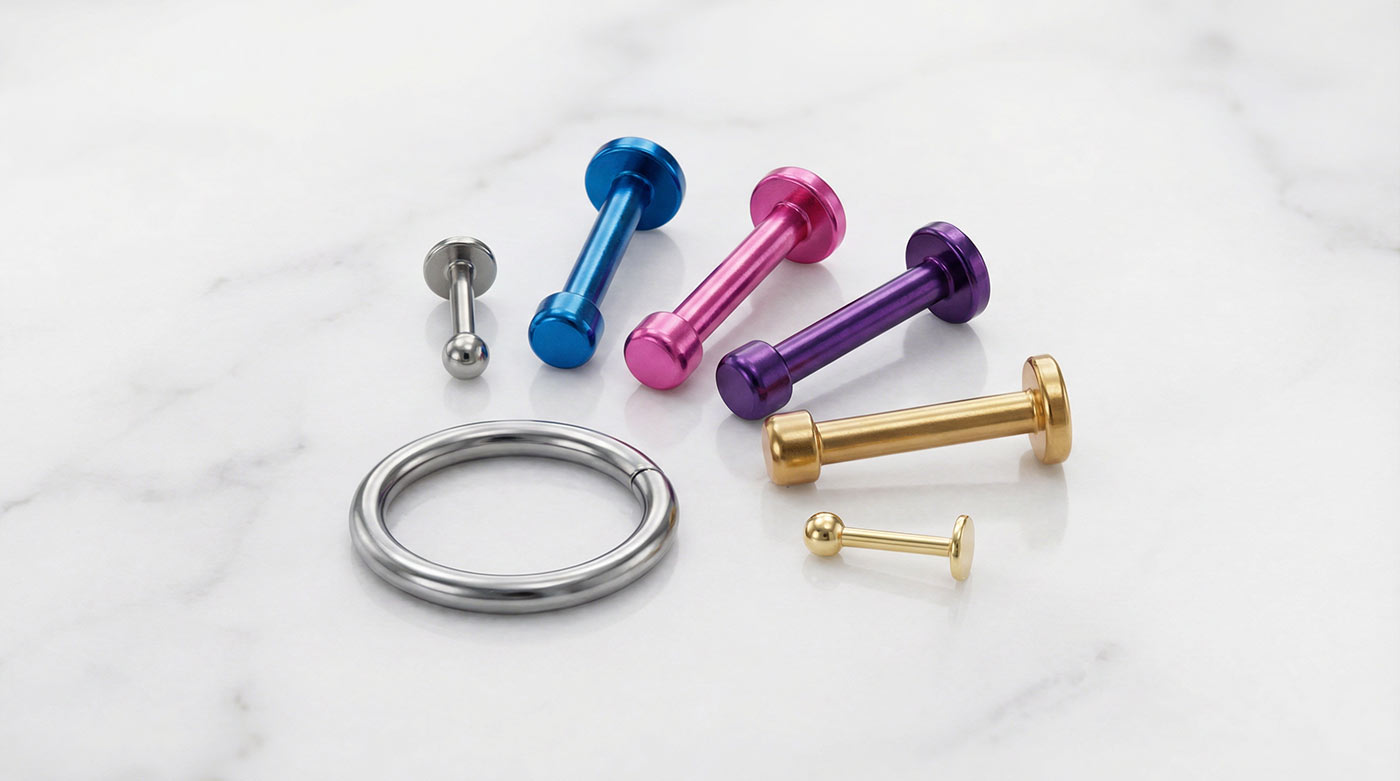
Coloured titanium jewelry (pink, blue, purple, gold, black) is anodized — an electrochemical process that changes the oxide layer on the surface without adding any chemical coating. Anodized titanium is just as biocompatible as plain titanium. This is how titanium can be colourful without being plated.
"Hypoallergenic" is not a regulated term. Any manufacturer can label jewelry "hypoallergenic" without any certification requirement. The only way to verify a jewelry claim is through the specific ASTM or ISO material grade. If a product only says "hypoallergenic" without citing ASTM F136 or equivalent, do not assume it is safe for new piercings.
What Causes Earring Allergies?
Understanding what causes reactions helps you identify and fix the problem:
| Cause | Reaction Type | How Common | Solution |
|---|---|---|---|
| Nickel | Contact dermatitis — itching, redness, oozing | Very common — 10–15% women | Switch to implant-grade titanium |
| Plating wearing off | Same as nickel — delayed reaction | Extremely common in fashion jewelry | Never use plated jewelry in piercings |
| Cobalt | Similar to nickel — less common | Less common | Verify ASTM certification of steel |
| Copper | Green/black skin staining | Common in brass/bronze alloys | Avoid brass, bronze, copper alloys |
| Sterling silver oxidation | Black/grey staining, irritation | Common | Use solid gold or titanium |
| Rough surface finish | Physical irritation, not allergy | Common in poor quality jewelry | Choose mirror-polished implant grade |
Troubleshooting a problem piercing: If your piercing is itching, weeping, or not healing after 3+ months of correct aftercare, the first change to make is the jewelry material — not the cleaning routine. Switch to implant-grade titanium and give it 4–6 weeks before drawing other conclusions. Resolving the material issue fixes the majority of persistent piercing problems. See our full jewelry materials guide for more.
Complete Materials Comparison Table
| Material | Nickel | Safe for New? | Safe for Healed? | Best For |
|---|---|---|---|---|
| Implant Titanium (ASTM F136) | Zero | ✅ Best choice | ✅ | All piercings, all skin types |
| Solid 14k/18k Gold (nickel-free) | Zero (if stated) | ✅ Premium | ✅ | Healed piercings, luxury jewelry |
| Implant Steel (ASTM F138) | Trace (0.05%) | ✅ Good | ✅ | Most people — not severe nickel allergy |
| Niobium | Zero | ✅ Good | ✅ | Nickel-sensitive — less common alternative to Ti |
| Solid Platinum | Zero | ✅ | ✅ | Premium alternative — very expensive |
| Sterling Silver (.925) | Variable | ❌ No | ⚠️ Short-term only | Only fully healed, non-sensitive skin |
| Gold Vermeil (gold over silver) | Variable | ❌ No | ⚠️ Healed only | Plating wears off — use solid gold |
| Gold-Plated | Base metal varies | ❌ Never | ❌ No | Not suitable for piercings |
| Fashion Jewelry / Unknown Alloy | Unknown | ❌ Never | ❌ No | Not suitable for piercings |
| Acrylic / Plastic (non-PTFE) | N/A | ❌ Never | ❌ No | Not biocompatible — degrades in body fluids |
Frequently Asked Questions
What is the best jewelry for sensitive skin?
Implant-grade titanium (ASTM F136) is the best jewelry for sensitive skin — 100% nickel-free, lightweight, and biocompatible with the highest tolerance of any piercing metal. Solid 14k/18k gold (explicitly nickel-free) is the premium alternative. Never use plated, sterling silver, or unknown alloy jewelry.
What does implant grade titanium mean?
Implant-grade titanium means titanium meeting ASTM F136 standard — the same grade used in surgical implants and bone screws. It guarantees zero nickel, lead, cadmium, or reactive metals. Always verify ASTM F136 or ISO 5832-3 certification. The term "implant grade" alone without citing the ASTM standard is not independently verified.
What metals cause earring allergies?
Nickel is the most common cause of earring allergies — affecting 10–15% of women. Cobalt and chromium cause reactions in some people. Copper causes green skin staining. Plated jewelry is a major culprit because the plating wears off exposing reactive base metals. Sterling silver often contains nickel in the alloy.
Is surgical steel safe for sensitive skin?
Implant-grade surgical steel (ASTM F138) is generally safe for most people but contains trace nickel (~0.05%) which can cause reactions in those with severe nickel allergies. For highly sensitive skin, implant-grade titanium is safer. Note: "Surgical steel" is an unregulated marketing term — always verify the ASTM grade.
Questions about jewelry for sensitive skin?
Drop them in the comments — we answer every one!