
Complete Guide · Ear Piercing Types
Types of Ear Piercings:
Pierced Ears Every Placement Explained
Every ear piercing type — helix, daith, tragus, conch, rook, lobe, industrial and more — ranked by pain level, healing time, and anatomy requirements so you can choose with confidence.
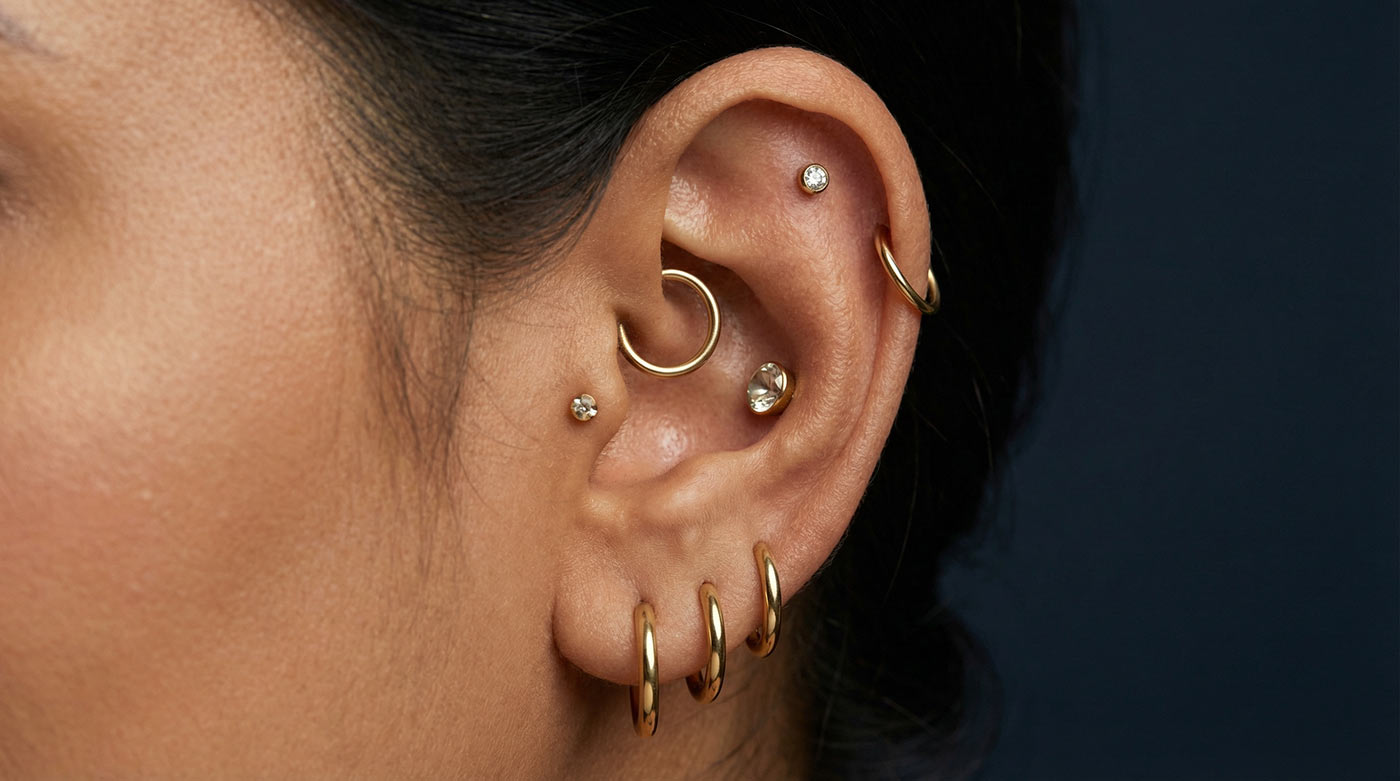
The ear is the most complex and versatile piercing location on the body — with over 15 distinct placement options, each with its own anatomy, pain level, healing requirements, and jewelry rules. This guide covers every single one.
Lobe Piercings — Soft Tissue, Fast Healing
Lobe piercings pass through the soft fatty tissue of the earlobe rather than cartilage. They heal faster, hurt less, and carry fewer complications than cartilage placements — making them the standard starting point for almost everyone.
Standard Lobe
The classic centre-of-lobe piercing. Works on all anatomies. The world's most performed piercing. Foundation of every curated ear.
Second / Third Lobe
Additional piercings stacked above the first lobe. The most popular multi-lobe configuration in 2026 — three matched studs up the lobe is a curated ear essential.
Transverse Lobe
A horizontal barbell through the lobe rather than straight through. A surface-style lobe piercing — both ends of the barbell are visible from the front. Higher rejection risk than standard lobe.
Helix Piercings — The Most Popular Cartilage Family
The helix is the outer cartilage rim of the ear. It is the most versatile cartilage location with six distinct placement options — all rated 4–5/10 for pain and 6–12 months healing.
Standard Helix
Upper outer rim. The most popular cartilage piercing globally. Recommended first cartilage piercing. Suits studs, hoops, and chains.
Double Helix
Two piercings stacked on the same rim. The fastest-growing cartilage combination in 2026. Matched or mixed jewelry styles.
Hidden Helix
In the inner helix fold — partially concealed from the front. The “quiet luxury” cartilage placement of 2026.
Forward Helix
Front-facing rim where ear meets head. Highly visible from the front. Great paired with a tragus for a front cluster.
Flat Helix
The large flat cartilage panel below the rim (scapha). Wide canvas for decorative statement jewelry and constellation placements.
Triple Helix
Three piercings along the rim. Dramatic stack — best planned with your piercer in one session for precise alignment.
Inner Ear Cartilage Piercings
Inner-Pierced Ears pass through the cartilage folds and ridges inside the ear bowl. They require more experienced piercers, are more anatomy-dependent, and generally have longer healing periods than helix piercings.
Daith
Innermost cartilage fold above the ear canal. Rumoured migraine benefits (not clinically proven). Best with curved barbells and clicker rings.
Tragus
Small cartilage flap over the ear canal. Dainty and unique. No in-ear earbuds during healing — the most important tragus rule.
Anti-Tragus
The small ridge opposite the tragus, above the earlobe. More anatomy-dependent. Striking and unusual — great in a front-of-ear cluster.
Rook
The anti-helix ridge above the daith. Anatomy-dependent — requires prominent inner fold. Visually striking because of the unusual jewelry angle.
Snug
Horizontal through the anti-helix ridge between inner conch and rim. High anatomy-dependence and higher rejection risk than most ear piercings.
Conch
The large cartilage bowl of the ear — inner (stud) or outer (orbital hoop). The most versatile cartilage piercing in terms of jewelry options.
Industrial
Two piercings connected by a single straight barbell — usually forward helix to standard helix. Bold, architectural. Both holes must heal simultaneously.
All Ear Piercings Ranked by Pain Level
Complete Healing Time Reference
| Piercing Type | Surface Healing | Full Healing | Difficulty |
|---|---|---|---|
| Standard Lobe | 6–8 weeks | 3–6 months | Easy |
| Upper / Second Lobe | 6–8 weeks | 3–6 months | Easy |
| Helix (all types) | 3–4 months | 6–12 months | Moderate |
| Flat Helix | 3–4 months | 6–12 months | Moderate |
| Forward Helix | 3–5 months | 6–12 months | Moderate |
| Tragus | 4–6 months | 6–12 months | Moderate |
| Daith | 4–6 months | 6–9 months | Moderate |
| Conch (inner/outer) | 4–6 months | 6–12 months | Moderate |
| Rook | 5–6 months | 6–12 months | Challenging |
| Anti-Tragus | 4–6 months | 6–12 months | Moderate |
| Industrial | 4–6 months | 6–12 months | Challenging |
| Snug | 5–7 months | 6–12 months | Most Challenging |
How to choose your first cartilage piercing: Start with a standard helix — it is the least painful cartilage placement, heals reliably, and gives you the full aftercare experience before attempting more complex placements. Once healed, add a daith or tragus next. Build toward rook and industrial last. See our Full Cartilage Piercing Guide for detailed advice on each placement.
Frequently Asked Questions
What are all the types of ear piercings?
The main types are: lobe (standard, upper, transverse), helix (standard, forward, flat, hidden, double, triple), daith, tragus, anti-tragus, conch (inner, outer, orbital), rook, snug, and industrial. Each has its own anatomy, pain level, healing time, and jewelry requirements.
What is the least painful ear piercing?
The earlobe is the least painful at 2/10. Among cartilage piercings, the helix is the least painful at 4/10 — making it the recommended first cartilage piercing. The most painful ear piercings are the snug (6.5/10), rook, and industrial (both 6/10).
What is the easiest ear piercing to heal?
The standard earlobe heals fastest in 3–6 months. Among cartilage piercings, the helix heals most reliably in 6–12 months. The most difficult to heal are the snug (highest rejection risk), industrial (two simultaneous piercings), and rook.
How many ear piercings can I get at once?
Most professional piercers recommend no more than 2–3 piercings per session. Multiple piercings stress the immune system simultaneously. For cartilage piercings, space them 3–6 months apart. An industrial counts as two piercings and should be planned accordingly.
Questions about choosing your next piercing?
Drop them in the comments — we answer every one!